Honey Pot Ants: The Living Pantries of the Colony
Honey pot ants are fascinating for their ability to store nectar, becoming true living pantries. This extraordinary behavior not only ensures the survival of the colony but also reveals much about the social complexity of these insects.
The Social Structure of Honey Pot Ants
Like an intricate symphony, the society of honey pot ants (Myrmecocystus mexicanus) reveals admirable complexity. In their colonies, each member plays a defined role, contributing to the collective harmony. From the workers to the queen, the social organization is a true test of cooperation and communication.
The workers, in particular, exhibit a surprising division of labor. Some act as foragers, while others focus on caring for the larvae in the colony. This specialization is not just a curiosity; it is essential for the colony’s survival. During their expeditions in search of nectar, these ants demonstrate extraordinary skill in navigating their environment. With agile movements, they become messengers of the vital food that sustains the community.
Moreover, the queen, whose longevity and reproductive capacity are extraordinary, plays a central role in the social dynamics. Her presence ensures the continuity of the group, while the workers dedicate themselves intensely to the maintenance and protection of the colony. This symbiotic and altruistic relationship is a fascinating example of how nature promotes the common good.
Thus, as we analyze the social structure of honey pot ants, we notice that each individual action has a significant impact. This leads us to reflect on the complexity of social behavior in other species. In upcoming chapters, we will delve into how nectar storage occurs and the adaptation of workers in this vital task, revealing more about these living pantries that are honey pot ants.
How Nectar Storage Occurs
As the sun rises on the horizon, a fascinating dance of honey pot ants (Myrmecocystus mexicanus) unfolds, revealing the extraordinary process of nectar storage. These ants, in their intricate colonies, possess a unique ability that not only distinguishes them but also sustains the life of the entire community. Entering this microcosm, it becomes evident how nectar, so sweet and precious, transforms into the vital fuel that drives their daily activities.
The Storage Process
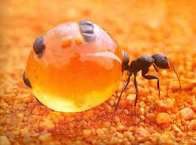
When the workers return from their floral expeditions, they transport nectar in their distended stomachs. This nectar, collected from various sources, is subsequently deposited in special cells within the nest. The ants not only store the nectar but also transform it through regurgitation, mixing it with enzymes to prevent fermentation. Thus, they ensure a fresh supply during scarce resource periods, revealing an impressive survival strategy.
Morphological Adaptations of the Workers
The workers of this species are true prodigies of evolution. They possess highly expandable abdomens, whose elasticity is vital for the efficient storage of nectar. The morphology of their mouthparts is also adapted for collecting and manipulating nectar. These characteristics not only make the ants more efficient but also have profound implications for the colony. The collective dedication to nectar collection and storage maximizes the colony’s resilience in times of uncertainty, demonstrating how morphological specialization strengthens teamwork.
Concluding this fascinating look at honey pot ants, we observe that nectar storage is not just a task but a pillar of the colony’s survival. This intricate process prepares us to explore the importance of nectar in the diet of these ants, revealing how it nourishes not only individuals but the very structure of honey pot ant society.
The Importance of Nectar in the Colony’s Diet
Imagine a world where small diligent beings work tirelessly to sustain their community. Honey pot ants (Myrmecocystus mexicanus) are not only remarkable for their storage abilities but also for their dependence on a precious source of energy: nectar. This sweet substance, produced by flowers, is fundamental to the diet of this vibrant and dynamic colony.
The Function of Nectar in the Colony
Nectar serves as a vital fuel that provides the necessary energy for the daily activities of the ants. The workers, responsible for collecting this precious substance, not only nourish themselves but also feed the larvae and the queen. This interdependent cycle ensures the harmonious functioning of the colony. Indeed, the abundant supply of nectar allows the colony to thrive, maintaining its social structure intact.
Nectar Collection: A Collaborative Effort
The act of collecting nectar is a joint effort that exemplifies the cooperation of the ants. They fly from flower to flower, using their sensitive antennae to detect attractive odors. It is in this delicate dance between flower and ant that the symbiotic relationship is revealed. As the ants transport nectar back to the nest, they ensure not only survival but also the growth of the colony. This behavioral pattern can be observed in many insect communities, demonstrating how interaction with plants shapes the ecology of the environment.
Understanding the importance of nectar is essential for us, as it allows us to appreciate how small organisms, like honey pot ants, play crucial roles in ecosystems. Thus, as the ants continue their quest for nectar, they engage in a cycle that sustains life and biodiversity. In the next chapter, we will explore the environmental adaptations of honey pot ants, where these incredible creatures demonstrate how their adaptive practices are essential for survival in a constantly changing world.
Environmental Adaptations and Survival
As we observe the intricate and vibrant colonies of honey pot ants, we are immediately captivated by the extraordinary unity of these insects. However, beyond the impressive scenes of cooperation, there is a remarkable adaptation that ensures their survival in different environments. Living in arid regions of the American Southwest, these ants go beyond mere survival; they have transformed their practices to extract vital sustenance from their surroundings.
Storage and Feeding Strategies
In an adverse environment, food scarcity is a constant threat. Thus, honey pot ants have developed a unique method of storage. Some workers become true “honey pots”; they store nectar and other liquids in their abdomens, allowing the colony to access a source of sustenance during long periods of drought. With this, the community survives, maintaining a subtle balance with the demands of the environment. This remarkable adaptation mechanism also relates to collection and storage practices, where ants at different life stages collaborate to maximize efficiency.
Response to Environmental Changes
In addition to feeding adaptations, honey pot ants demonstrate a remarkable ability to respond to rapid changes in their environments. They adjust the size and location of their nests according to climatic factors and resource availability. This flexibility is crucial for their survival, as through this capacity for adaptation, the colony ensures that the continuity of life is always resilience in motion. Thus, as we observe these skillful ants, we realize that their adaptive practices are not merely about survival; they represent a complex dance between necessity and transformation.
As we explore the next dimension of the lives of honey pot ants, which connects deeply with their adaptive practices, we enter the realm of ecological impact—where the contribution of these ants goes far beyond their own survival.
Impact of Honey Pot Ants on the Ecosystem
Honey pot ants, with their fascinating ability to accumulate nectar, are not only surprising in their behavior but also play a vital role in the ecosystem. These ants, by feeding and storing resources, act as a crucial link between flora and fauna, influencing the dynamics of the environment around them.
Role in Pollination
Although they are not primary pollinators, honey pot ants contribute indirectly to pollination. By visiting flowers in search of nectar, they transfer pollen from one plant to another. This process, although more subtle than that of bees, ensures that various plant species continue to thrive. Thus, they help sustain biodiversity by promoting the reproduction of plants that are essential for the survival of other organisms.
Soil Structuring
Moreover, honey pot ants play a significant role in soil structuring. Their excavation and tunneling activities increase soil porosity, facilitating aeration and water infiltration. This, of course, benefits other plants and organisms that inhabit the soil. Additionally, by transporting organic material and decomposing waste, they aid in nutrient recycling, enriching the land. Thus, each interaction of these ants in the environment reinforces the links of the ecological network.
Understanding the impact of honey pot ants on ecosystems is essential to appreciate the complexity of natural interactions. As we continue our journey, we will see how their contribution connects with other forms of life, revealing the intricate balance of nature.
Conclusions…
Honey pot ants play a crucial role in maintaining the resources of the colony, showcasing the incredible adaptation of species to their needs. Nectar storage generates a cycle of collaboration and independence among the workers, highlighting the social intelligence that characterizes these insects. The study of the interactions and behavior of this species broadens our understanding of biodiversity and the importance of cooperation in animal societies. By preserving the habitat of these ants, we ensure not only their survival but also the richness of the ecosystem in which they are embedded.
Did You Know?
What is the honey pot ant?
The honey pot ant (Myrmecocystus mexicanus) is a species that stores nectar in its abdomen, serving as a living pantry for the colony.
How do honey pot ants store nectar?
They have an expanded abdomen where they store the collected nectar, allowing the colony to be supplied when necessary.
What is the importance of this behavior?
This behavior ensures the survival of the colony during periods of food scarcity, functioning as a reserve system.
How do honey pot ants communicate?
They communicate primarily through pheromones, coordinating foraging activities and care for the young.
Are these ants social?
Yes, honey pot ants live in highly organized colonies, where each individual plays a vital role.
What is the natural habitat of honey pot ants?
These ants are found in desert and semi-arid regions, where nectar is an abundant food source during certain times of the year.
How to conserve honey pot ants?
Protecting their natural habitat and avoiding the use of pesticides is essential for the conservation of this important species.
Do these ants have predators?
Yes, like many other species, they can be preyed upon by birds, lizards, and other insects that feed on them.