The Fascinating Jumping Spider
The jumping spider, with its astonishing visual acuity and impressive leaps, is an extraordinary example of adaptation in nature. This article reveals the fascinating characteristics of this small predator that inhabits various environments, exploring its skills, behavior, and ecological importance.
Structure and Morphology
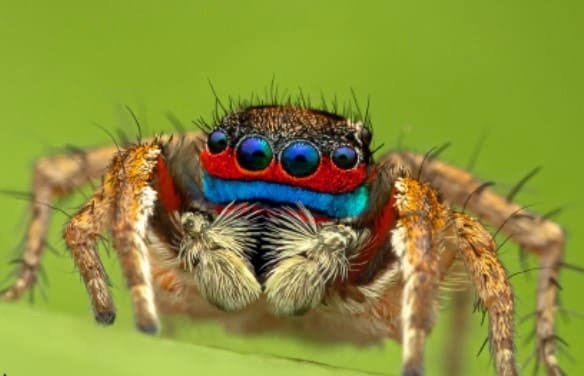
The jumping spider is a marvel of nature, artistic in its forms. Its morphology is a study of adaptive efficiency. The large, prominent eyes are a window to a vibrant world. They possess four pairs of eyes, allowing for stereoscopic vision that is essential for detecting movement. This sharp visual ability is remarkable for a predator. Their vision is so precise that spiders can successfully calculate distances when jumping.
The legs are the true masterpiece of this spider. They are long and muscular, adapted for spectacular jumps. The front legs are particularly developed, with powerful muscles that allow jumps up to 10 times the spider’s body length. The scales and structure of the hairs on the legs provide grip on uneven surfaces. This gives the spider a solid base before executing its impressive jumps.
Moreover, the jumping spider has a unique combination of joints that grants it agility. Each jump is meticulously planned and executed, revealing sophisticated predatory behavior. Upon spotting prey, its anatomical structure allows it to move quickly, attacking with precision. The impact absorption upon landing is facilitated by the elasticity in its joints.
These characteristics are crucial for the survival of the jumping spider in its habitat. The ability to move with agility and skill not only helps it capture prey but also avoids predators. For more on the friendliness and intelligence of this spider, check out this article.
Hunting Behavior and Feeding
The jumping spider is a true master of hunting, exhibiting remarkable skills that set it apart in the arachnid kingdom. Its diet is predominantly based on insects, which it captures with an impressive strategy. Instead of weaving complex webs, it uses its exceptional vision to identify potential prey. Its large, complex eyes provide almost panoramic vision, allowing for movement perception at long distances.
When a potential meal is spotted, the jumping spider prepares for a stealthy attack. It approaches slowly, taking advantage of the surrounding environment. Leaves, branches, and even small stones serve as cover, ensuring it remains hidden until the decisive moment. This camouflage behavior is a vital tactic to increase its chances of success.
The approach is meticulous. As soon as the prey is at a safe distance, the spider jumps with astonishing precision. The leap can be up to fifty times its body length. This jumping ability is complemented by a well-developed muscular system and a unique adhesion that allows it to grip various surfaces.
After capturing its prey, the jumping spider uses its powerful jaws to inject venom, which not only paralyzes its victims but also begins the digestion process. Digestion occurs externally, allowing it to feed on already decomposed substances. With these skills, the jumping spider demonstrates adaptive behavior that positions it as one of the most effective predators in its habitat. To learn more about the fascinating adaptations of the jumping spider, check out this article.
Habitat and Distribution
Jumping spiders are adaptable and can be found in an impressive variety of habitats. They can be seen in tropical forests, open fields, urban gardens, and even inside homes. These spiders, belonging to the Salticidae family, prefer environments that offer both shelter and hunting opportunities. They often hide in leaves, tree bark, and rocks, utilizing their natural camouflage.
The geographical distribution of jumping spiders is equally fascinating. They can be found on every continent except Antarctica. This wide range is a result of their ability to adapt to different climatic conditions and ecosystems. For example, species that inhabit tropical forests have more vibrant coloration, while those living in arid regions have more subdued colors.
Factors influencing the presence of jumping spiders include the availability of prey and the surrounding vegetation. In regions with high biodiversity, these spiders thrive, feeding on insects that inhabit their environment. Their ability to jump long distances also offers advantages in hunting. Additionally, pollution and climate change can impact their habitats, reducing species diversity and possibly the spider population itself. To admire the exciting characteristics of these creatures, observe them in their natural habitat.
Ecological Importance
The jumping spider plays a crucial role in ecosystems, serving as an efficient natural control of insects. Agile and skilled predators, they feed on various insects, including aphids and flies, which can be harmful to plants. This predator-prey dynamic contributes to ecological balance. By reducing pest populations, these spiders help maintain plant health, promoting biodiversity.
The interactions of the jumping spider go beyond hunting. They also attract larger predators, such as birds and small mammals. The presence of these spiders in a habitat can indicate a healthy and balanced ecosystem. As efficient predators, they integrate into the food web, which is vital for environmental stability.
Moreover, jumping spiders can interact with pollinators. Although indirectly, their control of pest insects can allow for an increase in the frequency of pollinators, such as bees, which depend on a healthy environment. The spider can also be seen as an indicator of habitat quality, as its presence often suggests proper pest control.
In summary, by regulating insect populations, the jumping spider not only protects vegetation but also fosters the overall health of ecosystems. Every interaction that occurs due to its presence illustrates the richness of biodiversity and the importance of maintaining such organisms in our natural environments. For more information on the fascinating behavior of this arachnid, visit Jumping Spider: the Most Intelligent Arachnid.
Curiosities and Myths
The jumping spider, with its exceptional jumping ability, sparks fascination and curiosity. Many people believe that these arachnids are aggressive, but in reality, they are more fearful than threatening. When they feel threatened, they often prefer to flee rather than attack. This characteristic is particularly highlighted in their interaction with humans, as they are more likely to hide than expose themselves. Another common myth is that the jumping spider has poor vision. In contrast, its large eyes are perfect for detecting movement and calculating distances, essential for its hunting technique. These eyes also provide impressive depth perception, allowing them to jump with surprising accuracy.
In popular culture, the jumping spider is often misrepresented, creating an image of villainy. However, in reality, these arachnids are admired in the scientific community for their remarkable behavior, including the ability to stretch their front legs as if presenting themselves. This display is not only a way to attract mates during the breeding season but can also be a defensive strategy to appear larger to predators.
In many cultures, spiders are seen as symbols of weavers and creators, reflecting the jumping spider’s ability to build complex strategies to capture its prey. This fascinating behavior makes it a true artist in the animal kingdom. For more information on the intelligence of this arachnid, check out the article on the jumping spider as the most intelligent arachnid.
Conclusions…
In summary, the jumping spider is an intriguing example of adaptation and survival. Its ability to jump long distances and its keen vision not only make it an efficient predator but also reveal the complexity of wildlife. Understanding these creatures is essential for preserving ecological balance.
Did You Know?
What are the characteristics of the jumping spider?
The jumping spider stands out for its sharp vision, compact body, and ability to make long jumps using its strong hind legs.
Where can the jumping spider be found?
This arachnid can be found in various habitats, including forests, gardens, and urban areas, having a vast geographical distribution.
What is the ecological role of the jumping spider?
The jumping spider plays a crucial role in insect control, contributing to the health of ecosystems by regulating pest populations.
How does the jumping spider capture its prey?
It uses its excellent vision to locate prey and makes calculated jumps to capture them, demonstrating impressive predatory skills.
Is the jumping spider dangerous to humans?
Generally, the jumping spider does not pose a threat to humans, as its venom is weak and its nature is more geared towards hunting small insects.