The Fascinating Flying Snake
The flying snake, one of nature’s most intriguing reptiles, surprises with its ability to glide among the treetops. In this article, we will dive into the characteristics, habitat, and myths surrounding this extraordinary creature, revealing the joy of observing its unique behavior.
The Origin of the Flying Snake
The flying snake, an enigma of evolution, has developed the fascinating ability to glide through unique adaptations over millions of years. Through the dense forests of Southeast Asia, where they reside, these reptiles face significant challenges. The environment, complex and three-dimensional, required innovative methods of locomotion to survive.
Evolution and Adaptations
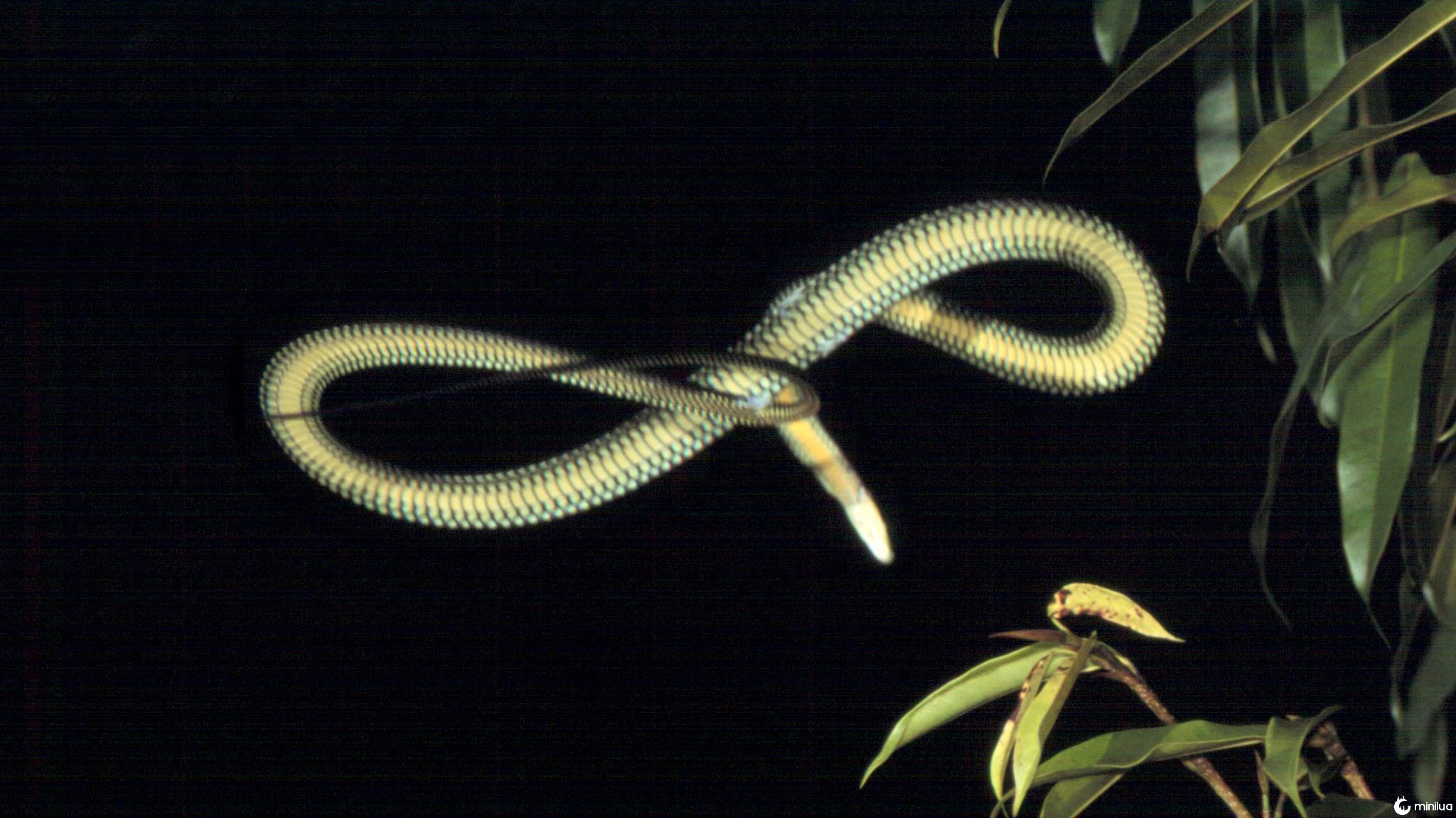
The key to the flying snake’s gliding ability lies in its body, whose evolutionary adaptations occurred over generations. The ribs expand laterally, flattening the body to increase the surface area for ‘flight.’ This transforms its generally cylindrical body into a concave shape, ideal for lift in the air.
Ancient Origins
The evolutionary roots of flying snakes can be traced back to terrestrial ancestors that lived in habitats where aerial locomotion offered a significant evolutionary advantage. This change was critical for escaping predators and efficiently hunting prey in their arboreal domain. The ability to glide developed as a response to these ecological challenges. By adopting this strategy, flying snakes maximized their use of the three-dimensional environment of tropical forests. More than just a method of locomotion, gliding among the trees effectively reduced competition for resources on the ground.
Evolution is not always a straightforward and predictable path. Instead, subtle adaptations occurred over immense periods. Flying snakes bring to light a wonderful tapestry woven by natural selection. True exemplars of nature, they are compared to other animals adapted to their environment, such as the jumping spider, which has developed remarkable jumping abilities.
Gliding Mechanisms
The flying snake possesses an extraordinary ability to defy gravity. When it launches into the air, it does more than just jump. It transforms its slender body into a living wing, the result of a complex adaptive arrangement. With synchronous movements, the snake flattens its body, expanding its ribs to create a concave surface. This shape increases lift during flight. Additionally, the snake undulates, replicating a technique similar to swimming, but now in the air. This continuous lateral movement not only stabilizes the snake but also gives it directional control. Science identifies this process as a form of aerodynamics, where the snake, despite lacking wings, precisely controls its trajectory. The ability to glide for up to 100 meters between trees is a crucial evolutionary adaptation. In its natural environment, this offers significant survival advantages. By avoiding terrestrial predators and reaching food sources more quickly, the flying snake maximizes its hunting time and reduces risks. This aerial mobility also allows it to colonize larger areas of forest, expanding its opportunities for survival and reproduction. In a natural world filled with dangers and opportunities, each leap of the flying snake is a masterclass in evolutionary adaptation. Understanding these intriguing flight mechanisms continues to inspire scientists and nature enthusiasts. To explore other fascinating adaptations, such as observing living beings that defy natural expectations, reading about the jumping spider can be revealing.
Habitat and Distribution
The flying snake, one of the most intriguing reptiles, inhabits the lush tropical forests of Southeast Asia. From India to Indonesia, it is primarily found in dense forest environments. These forests, rich in biodiversity and humidity, provide the ideal habitat for the survival and reproduction of these incredible species.
A notable feature of these regions is the abundant presence of tall trees and thick vegetation. Flying snakes use these trees as an intricate aerial navigation network, launching themselves from one trunk to another with phenomenal skill. The dense branches and leaves offer both protection from predators and opportunities for hunting. It is in this labyrinth of wood and leaves that the flying snake finds a unique advantage in its special locomotion abilities.
Their geographical distributions are broad, covering a variety of ecological regions. The warm and humid climate of these areas is essential for their survival. The tree canopies provide varied microclimates that meet the thermal and hydrological needs of the snakes. Furthermore, these areas often harbor a large number of potential prey, from small reptiles to tree-dwelling insects.
The role of flying snakes in these environments is significant. They contribute to controlling prey populations and maintaining ecological balance. These overcrowded habitats are not only home to flying snakes but also to countless other species. In our reading about the toucan, also mentioned for its aerial adventures, we can see how these dense woods hold unique secrets and beauties of nature.
Behavior and Diet
The flying snake, known for its unparalleled gliding ability, exhibits fascinating behavior in its natural habitat. During its hunting expeditions, it takes advantage not only of its ground skills but also of its incredible ability to launch from tree to tree. This ability, while originally defensive, also allows for unexpected approaches to its prey.
These snakes primarily feed on small animals, such as lizards, frogs, birds, and even insects. Patiently observing from above, they identify movement in the foliage below. With impressive precision, the flying snake launches into the air, gliding gracefully toward its victim.
A hunting flying snake is extremely efficient due to its stealthy skills. They maximize the three-dimensional environment of the jungle. The movement of their aerial dance is perfectly synchronized, ensuring that nothing is safe from their voracious hunger.
Few creatures are as well adapted to their way of life as the flying snake. Its aerodynamic body, combined with its impressive gliding strategy, offers a crucial advantage. The very trees of the tropical forest become allies, serving both as observation fields and as hunting vehicles.
Compared to other predators in its region, the flying snake masters the art of aerial attack. It exemplifies silent efficiency, turning the element of surprise into its greatest weapon. Observing this snake in action reminds us of the wonderful complexity and adaptation of the natural world. This peculiar behavior not only attracts the curiosity of scientists but also fuels local mythologies. Learn more about other surprising hunters in nature.
Culture and Myths
In the trajectory of mythology and folklore, few creatures have captivated human imagination as much as the flying snake. For many, these snakes represent the living embodiment of ancient legends describing mythical serpents tearing through the skies. Notorious for their gliding ability, flying snakes are often associated with mystical powers in Asian cultures. In regions like Thailand and Malaysia, stories describe celestial snakes that guard the secrets of the universe or grant good luck to the worthy.
However, it is not only hope and admiration that these snakes evoke. In some traditions, the flying snake is also seen as a bearer of ill omens. Legends speak of flying snakes that herald natural disasters, while other myths claim they are guardian spirits ready to punish those who disturb their territory in the forest. In more modern cultures, the flying snake has gained roles in films and literature, promoting both fascination and a subtle chill down the spine. It represents the duality present in many of us: the fear of the unknown and the admiration for everything that is unusual and extreme in nature. The internet has played a crucial role in disseminating videos and images of these gliding snakes, enhancing both their legends and the fascination with their peculiar biology. For some, the flying snake is a scientific wonder, a living example of the marvels of evolution. Similarly, other enigmatic creatures like the jumping spider also challenge myths and reveal the wonders of nature. Thus, the flying snake continues to weave our stories and awaken our curiosity.
Conclusions…
The flying snake is a spectacle of nature, with unique abilities that distinguish it among reptiles. By uniting science and curiosity, we delve into its biology, habitat, and the various facets of popular culture. The preservation of its habitat is vital to ensure that this incredible creature continues to amaze future generations.
Did you know?
Is there a flying snake in Brazil? Yes, the flying snake can be found in some regions of Brazil, especially in tropical forests.
Which snakes can fly?
Flying snakes belong to the genus Chrysopelea, which includes several species known for their gliding ability.
What is the name of the snake that has wings?
Although they do not have true wings, flying snakes have a unique adaptation that allows them to glide, hence they are called flying snakes.
What is the myth of the flying snake?
Myths about flying snakes often include stories of their supernatural abilities, such as the power to fly long distances, which captivates popular imagination.
What is the snake that flies?
The snake that flies is the flying snake, which belongs to several species of the genus Chrysopelea, exemplifying remarkable adaptations.
What is the most dangerous snake in Brazil?
The jararaca and the rattlesnake are considered some of the most dangerous snakes in Brazil due to their potent venom.