Dwarf Caiman
The dwarf caiman is a fascinating species of crocodilian that captivates the imagination. With its diminutive stature and nocturnal behavior, these creatures inhabit swampy regions and are true masters of camouflage. Let us explore the world of these intriguing creatures, from their habits to their interactions within the ecosystem.
Physical Characteristics
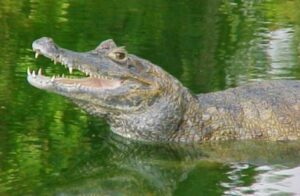
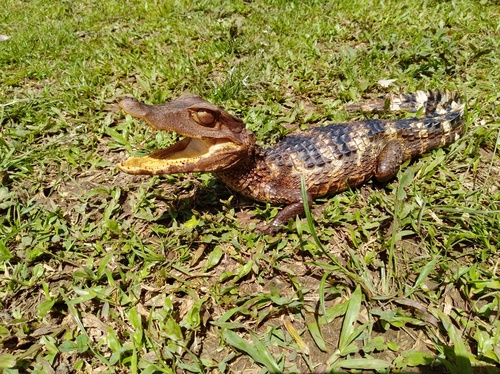
The dwarf caiman, a stealthy creature of swamps and rivers, possesses physical characteristics that make it a true master of camouflage. This reptile, one of the smallest members of the crocodilian order, measures between 1.5 and 1.9 meters when it reaches adulthood. Its compact and muscular body is incredibly agile, allowing it to move silently through shallow waters and dense vegetation.
The coloration of the dwarf caiman is a mix of dark olive greens and deep browns, creating patterns that resemble the muddy environment in which it lives. These colors are not merely aesthetic; they serve a vital purpose. When the caiman is partially submerged or hidden under vegetation, its colors allow it to blend in perfectly, making it almost invisible.
In addition to its coloration, this small crocodilian has robust and heavily armored skin, especially on the upper part of its body, which not only protects it from predators but also from potential rivals. This adaptation is particularly useful in its habitat, where encounters with other predators are common. The eyes of the dwarf caiman, positioned on top of its head, allow it to see while remaining almost completely submerged. Its short, sturdy legs, equipped with sharp claws, enable it to move easily both in water and on land. Thus, the dwarf caiman uses its natural skills and adaptations to survive in a challenging habitat shared with various forms of wildlife, such as the Brazilian **biguatinga**.
Habitat and Distribution
The unique dwarf caiman inhabits vast stretches of South America, hiding in the shadows of dense tropical forests. It favors the shady surroundings of calm, flooded streams. These aquatic environments provide not only protection but also an abundance of food, essential for its survival.
With a discreet behavior, this reptile prefers slow-moving, shallow waters, where it occasionally emerges to bask on logs. This thermoregulatory behavior is vital for regulating its body temperature. During rainy periods, it moves through flooded areas, discreetly expanding its hunting territory.
Geographically, the territory of the dwarf caiman spans from eastern Colombia to northern Brazil, passing through Venezuela, Guyana, and Peru. It inhabits areas such as the Amazon biome and the Pantanal, where the majesty of nature maintains its own rhythm. These destinations resonate with mystery, while the dense vegetation offers shelter and hunting opportunities.
In the humid atmosphere of these forests, the dwarf caiman remains vigilant. Its exceptionally sharp topographical knowledge allows it to navigate the complex networks of rivers and swamps. Despite its small size for a crocodilian, its presence commands respect among the masters of the aquatic realm.
To learn more about the fascinating inhabitants of Brazilian forests, explore this article about the **biguatinga**, a bird equally adapted to the aquatic environment.
Nocturnal Behavior
As night falls in the Amazon, the dwarf caiman comes to life, revealing a world of fascinating behaviors under the soft light of the moon. This compact crocodilian adeptly adapts to the darkness, moving with silent efficiency through the water. The silence of the night is its ally, allowing it to stealthily approach its prey, which ranges from small fish to aquatic insects.
During these nocturnal expeditions, the dwarf caiman utilizes its incredible night vision, an essential adaptation for hunting in the forest’s gloom. Its eyes shine with a supernatural hue when illuminated, reflecting the light that filters through the tree canopy. This characteristic not only enhances its visual perception but also gives it a strategic advantage against unsuspecting predators and prey.
The nocturnal behavior of the dwarf caiman is not solely predatory; it also engages in staying hidden from potential threats. The thick vegetation along the riverbanks offers the perfect hiding spot. There, it rests patiently, being practically invisible among the branches and leaves. This carefully chosen environment also serves as a stage for social interactions.
Although generally solitary, throughout the night, the dwarf caiman may cross paths with other wildlife in the forest. Conflicts are rare, often replaced by a balanced state of coexistence. Each creature maintains a respectful distance, avoiding unnecessary disturbances in their nocturnal activities.
Interestingly, the hunting pattern of the dwarf caiman mirrors the calculated patience observed in other aquatic predators, as seen in the article about bats that adapt to dark environments. This nocturnal existence allows the dwarf caiman to strengthen its role in the delicate balance of its ecosystem.
Diet and Feeding
In the heart of the tropical forests of South America, the small yet formidable dwarf caiman emerges as a cunning and efficient predator. This reptile has a varied diet, but it is predominantly carnivorous. Its menu includes small fish, crustaceans, amphibians, and even small mammals and birds when the opportunity arises.
With a remarkable parallel to the behavior of the Ladybug, which also plays a crucial role in its ecosystem, the dwarf caiman activates the local food chain by regulating the population of its prey. This maintains the delicate balance of aquatic systems while creating opportunities for other species.
The diet of the dwarf caiman varies according to age and size. Juveniles rely more on aquatic invertebrates and insects, while adults incorporate larger prey into their diets. This transition not only influences the structure of the aquatic community but also impacts local prey populations.
The feeding behavior of dwarf caimans also makes them significant in the trophic chain. As both predators and prey, they establish ecological links that ensure the efficient transfer of energy across trophic layers. This connection highlights the importance of their role within the ecosystem.
Moreover, their presence encourages biodiversity and habitat health. When predators like the dwarf caiman thrive, they ensure that prey species do not multiply uncontrollably, preventing resource depletion. Thus, the seemingly small and modest dwarf caiman reveals itself as a fundamental piece in the ecological puzzle of the tropical regions it inhabits.
Conservation and Threats
The dwarf caiman, despite its robust appearance and adaptable nature, faces significant threats in its natural habitat. Habitat destruction is one of the most pressing challenges the species faces. Agricultural expansion and deforestation for pasture creation are fragmenting and reducing its tropical forest areas in South America.
Additionally, illegal hunting remains a serious problem. Despite measures in place, many dwarf caimans are captured for the illegal pet trade and products derived from their bodies.
Climate change should also not be underestimated. Rising temperatures and variations in precipitation can significantly alter the freshwater habitats and food chain of dwarf caimans.
Indirect human impact, such as pollution of waterways with heavy metals and pesticides, poses additional risks. Combined, these factors make the implementation of urgent conservation measures essential. Preserving the dwarf caiman is important not only for maintaining the ecological balance of its natural habitat but also as a matter of global biodiversity conservation.
The introduction of environmental education programs, coupled with policies to protect native areas, are crucial steps. Identifying critical zones for preservation and monitoring the population helps direct efforts toward the most threatened areas.
Finally, working together with local communities to promote sustainable practices can help ensure a safer future for these fascinating creatures. Efforts to protect these species are essential for maintaining the delicate balance of nature, as is the case with the elephant, the gentle giant of nature, which also faces similar challenges.
Conclusions…
The dwarf caiman, with its modest dimensions and fascinating behaviors, deserves recognition in the ecosystem. Understanding its biology and habitat is crucial for the conservation and protection of these nocturnal creatures that play important roles in nature.
Did You Know?
What is the size of the dwarf caiman?
The dwarf caiman typically reaches a size between 1.2 and 1.5 meters, making it one of the smallest crocodilians.
What is the smallest species of caiman?
The smallest species of caiman is the dwarf caiman, due to its reduced stature compared to other species.
What does jacaré-paguá mean?
Jacaré-paguá is another name for the dwarf caiman, used in some regions, reflecting its characteristics and small size.