Nautilus: The Living Fossil Mollusk That Captivates Science and Nature
The Nautilus is one of the most fascinating marine creatures, known as a living fossil mollusk. With its unique characteristics, it offers valuable insights into the evolution and diversity of marine life.
Origin and History of the Nautilus: A Relic from the Past
Emerging from the depths of time, the Nautilus represents a living time capsule, providing a glimpse into the ancient oceans that covered the Earth over 500 million years ago. This mollusk, with its emblematic spiral shell, is not just a survivor of geological history but also a silent narrator of the eras it has witnessed. The Nautilus belongs to an ancient group of cephalopods, carrying secrets from prehistoric times that many other living beings did not survive.
The geological history of the Nautilus takes us back to the Cambrian period, a time when marine life began to flourish. During this era, the skies were devoid of birds and the continents of mammals, but the oceans teemed with a diversity of life forms. Surprisingly, throughout its long evolutionary history, the Nautilus has changed very little. Its shell, used for both defense and buoyancy control, has remained its unaltered trademark over the ages, demonstrating an adaptation so perfect that it eliminated the need for evolution.
The Nautilus’s ability to traverse millennia lies in its incredible adaptability and its deep, stable ocean habitat. The dark depths and cold waters of the abyss, little altered by cataclysms like asteroids or volcanic activity, provided a sanctuary that many other species did not have the privilege to enjoy. The continued existence of the Nautilus teaches us about the resilience of life and the constant change of marine ecosystems over the ages.
With this depth of history, we retire from our fascination with the origin and evolution of the Nautilus to dive into the peculiarities of its biology and morphology in the next chapter, elucidating aspects such as its splendid spiral shell and its survival mechanisms in deep marine environments.
Biological and Morphological Characteristics of the Nautilus
As we emerge from the mysterious depths of its evolutionary context, we now dive into the celebrations of the Nautilus’s complex physical constitution. This intriguing being, with its spiral shell, offers more than a visual spectacle; it is an elevated capsule of the secrets of the adaptive marine world.
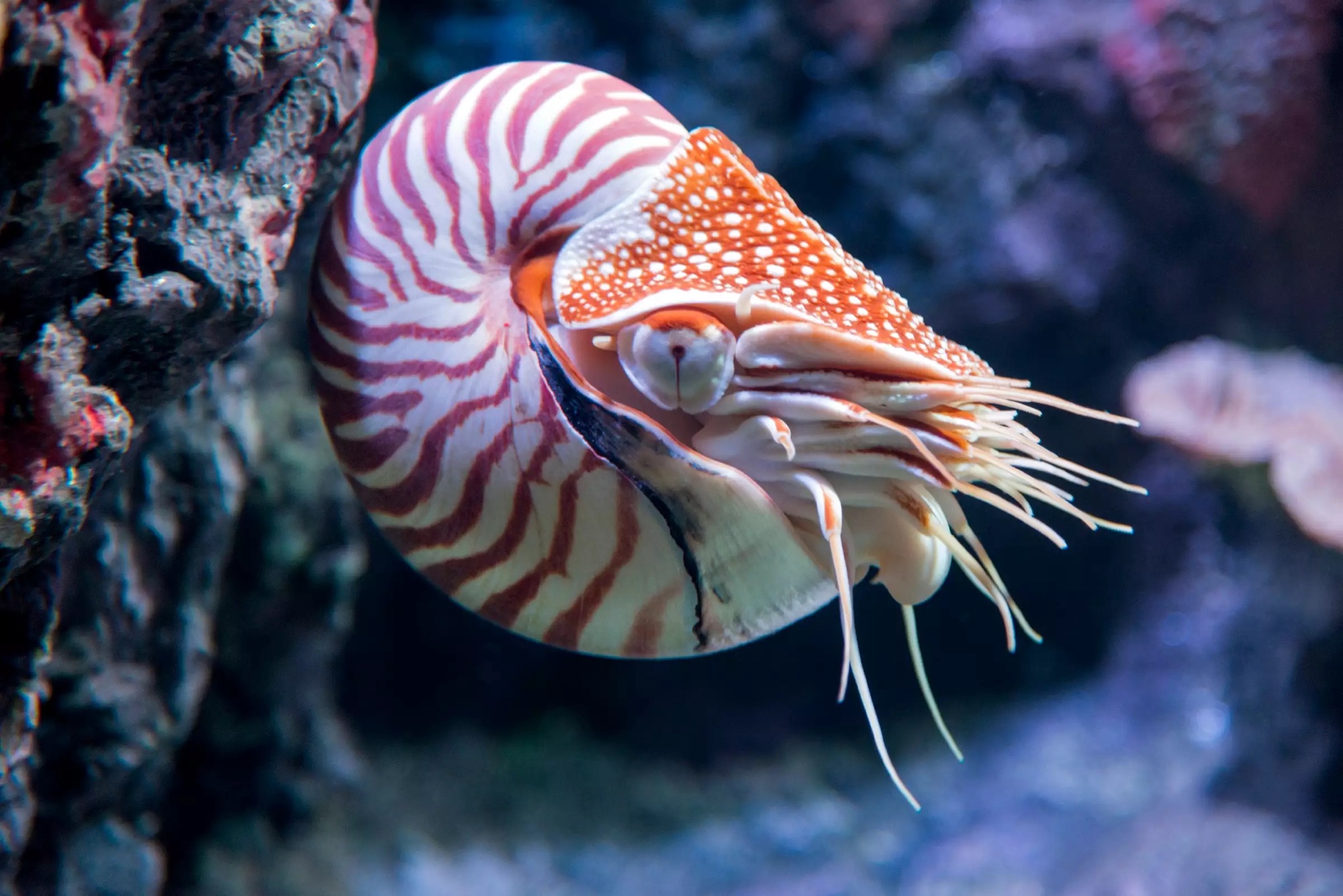
The Nautilus exhibits a characteristically spiral shell, whose geometric beauty is typical. The shell is internally divided into numerous chambers connected by a central tube, the siphuncle. This arrangement not only provides structural strength but also plays a vital role in the animal’s buoyancy mechanism. By adjusting the gas within these chambers, the Nautilus can control its density and buoyancy, moving vertically with admirable precision through the oceans.
Crucial for survival in deep waters are its biological adaptations; the Nautilus has an exceptionally slow metabolism, allowing it to conserve energy in the cold, dark marine abysses. It primarily feeds on crustaceans, taking advantage of its ability to detect prey with vision highly adapted for low light. This diet is essential, contrasting with the faster and more energetically demanding shallow-water predators.
Furthermore, the Nautilus’s ability to retain nitrogen helps balance its buoyancy—a fascinating phenomenon that can be further explored in the study of the squid, comparing the buoyancy mechanisms of these mollusks. In this intricate dance of survival, every trait of the Nautilus is an evolutionary response to the challenges of the deep marine environment.
Habitat, Behavior, and Feeding
As we dive into the blue depths of the Indo-Pacific ocean, we encounter a scene rich in biodiversity where the Nautilus, this living relic, weaves its daily life immersed in mystery and survival. These primordial mollusks reside on the outer slopes of coral reefs and in deeper waters, enjoying the shelter and abundant food these ecosystems provide. During the day, they prefer the cool depths of approximately 300 to 500 meters below the ocean surface, ascending at night to feed and interact.
The Nautilus’s diet consists mainly of detritus, crustaceans, and occasionally small fish, captured with its numerous tentacles that display a spectacle of precision and predatory efficiency. They use an ingenious jet propulsion method to move, expelling water to navigate their aquatic world in an underwater ballet that sustains a life of stealth and strength.
Curiously, Nautiluses do not have good vision, despite their large and seemingly expressive eyes. Instead, they rely on their sense of smell and the touch of their tentacles to explore the environment and seek food. The ability to adapt to the most diverse conditions is undoubtedly one of the advantages that have allowed their survival through millennia, facing climatic changes and oceanographic transformations that challenged many other species to adapt or perish.
However, this ancient mollusk faces new challenges in the modern marine ecosystem. Overfishing and habitat degradation are constant threats that put these creatures in danger. The importance of protecting marine habitats cannot be underestimated, as a lung for sea biodiversity, including the mysterious Nautilus.
Just as farmers care for the land they cultivate, we must care for the oceans that house such fascinating creatures. The conservation of these environments is vital both for biodiversity and for the continuity of scientific research exploring the evolutionary secrets of Nautiluses. It is precisely the science that seeks to better understand these invaluable phenomena that will be explored in the next chapter.
The Scientific and Environmental Importance of the Nautilus
As we advance in our journey through time, we find in the Nautilus a repository of biological stories that date back to past eras. This mollusk, with its characteristic spiral shell, provides scientists with valuable insights into the evolution and resilience of our marine ecosystem.
The Nautilus is meticulously studied in the field of evolutionary biology. Through its nearly unchanged anatomy over millions of years, we learn about the stability and changes in ancient seas that shaped current marine life. It has become an icon of biological persistence, a true time capsule illustrating theories of species evolution and extinction. Furthermore, its ability to regulate its buoyancy reveals complex adaptive mechanisms, essential for understanding marine survival over geological eras.
Currently, researchers use the Nautilus to better understand environmental changes in the oceans. It is seen as an indicator of coral reef health and a signal of ecological changes caused by human activities, such as marine pollution. This mollusk shows how small environmental changes can lead to significant transformations in marine biodiversity. Therefore, it becomes crucial in conservation studies, helping to design strategies for the protection of marine ecosystems.
We will advance in the next section on conservation efforts and curiosities surrounding this fascinating mollusk. By recognizing the threats it faces and exploring the most peculiar aspects of its existence, we seek to inspire a broad and deep appreciation of the Nautilus and its evolutionary journey.
Conservation and Final Curiosities about the Nautilus
After exploring the extraordinary biology and evolutionary history of Nautiluses, it becomes crucial to discuss their conservation. Despite their enigmatic beauty and ecological importance, these creatures are threatened by factors such as predatory fishing and habitat destruction. The demand for their unique shells, often used in jewelry and decorations, puts these mollusks at increasing risk.
International organizations have intensified efforts to protect Nautiluses, promoting stricter laws against the illegal trade of their shells and supporting monitoring projects in their natural environments. Additionally, educational awareness programs aim to inform the public about the consequences of exploiting these ancient animals.
Curiously, Nautiluses have more than 90 tentacles without suckers, distinguishing them significantly from other cephalopods. Their ability to float is adjusted through an internal chamber system in their shell, which they modify by adjusting internal gas and liquid levels. This ability is an evolutionary spectacle, allowing them to navigate coral reefs precisely in search of food.
For those enchanted by these deep-sea beings, it is vital to take conservation actions and educate others. Access more information about marine life and how to participate in preservation efforts. Together, we can ensure that Nautiluses endure, not just in our minds and stories, but also in the vast oceans of our planet.
Conclusions…
Following the history and characteristics of the Nautilus is to dive into a remote past, as this living fossil mollusk spans millions of years with little alteration. Its spiral shell and complex biology make it a symbol of natural resilience and the importance of oceans for biodiversity. By getting to know the Nautilus better, we also value the efforts for the conservation of species and marine environments. Moreover, its study continues to inspire science and technology, demonstrating how nature can be a source of continuous learning. Finally, the admiration for this ancestral survivor reinforces the curiosity and respect we have for our planet and its unique forms of life. Did you enjoy this post? Like, comment, and share so we can keep creating! Did you know?