The Ladybug and Our Lady
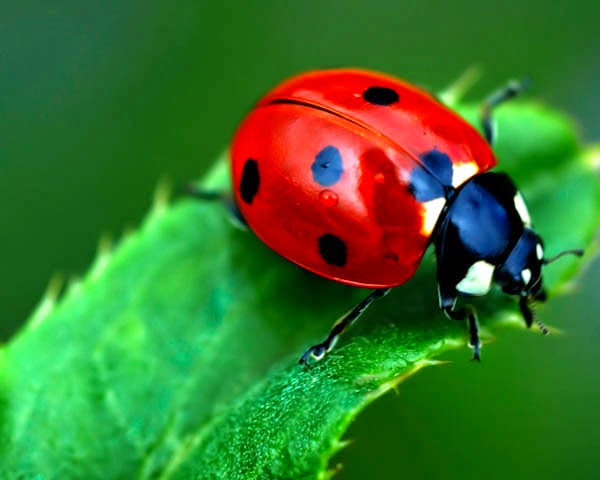
The Coccinellidae family, also known as ladybugs, includes approximately 5,000 widely distributed species of beetles (order Coleoptera) whose name originated in the Middle Ages in Great Britain when the beetle was dedicated to the Virgin Mary and called ‘Our Lady’s Beetle’. Our Lady was often depicted in early artistic paintings wearing a red cloak, and the spots of the seven-spotted ladybug (the most common in Europe) symbolized her seven joys and seven sorrows.
Ladybugs are hemispherical in shape and typically measure 8 to 10 mm in length. They have short legs and are usually brightly colored with black, yellow, or reddish spots. The color of the wing covers and the number of spots vary among species. The pattern of the nine-spotted ladybug (Coccinella novemnotata), which has four black spots on each reddish-orange wing cover (elytron) and a shared spot, is an example of the typical color pattern of ladybugs.
Life Cycle
The life cycle takes about four weeks, allowing several generations to be produced each summer. The long, slender, soft-bodied larvae, usually gray with blue, green, red, or black spots, feed on other insects and insect eggs. The larvae go through four growth stages and then attach to an object and pupate in their last larval skin. Large groups of ladybugs often hibernate together each winter in the same location.
Benefits in Agriculture
Clusters of ladybugs are often collected and sold to farmers and gardeners to control pest insects such as aphids, scales, and mites. The Australian ladybug, or vedalia beetle (Rodolia cardinalis), was brought to the western United States to help combat an outbreak of cottony cushion scale (Icerya purchasi), which threatened to ruin citrus orchards. Both the larvae and adults of the convergent ladybug (Hippodamia convergens) are important predators of aphids.
Feeding
Although most ladybugs and their larvae are carnivorous, several feed on plants and can be quite destructive. Two of them are the squash beetle (Epilachna borealis) and the Mexican bean beetle (E. varivestis).
The familiar children’s rhyme ‘Ladybug, ladybug, fly away home / Your house is on fire, your children are alone’ referred to the burning of hop vines in England that occurred after the harvest and cleared the fields, but also killed many ladybug beetles. In folk medicine, ladybugs are prescribed as remedies for colic, measles, and toothaches. But all of this is mere superstition.