Axolotl: The Mexican Amphibian with Incredible Regeneration
The axolotl, one of the planet’s most intriguing creatures, captures the attention of scientists and curious minds alike. This Mexican amphibian not only displays a fascinating appearance but also possesses the remarkable ability to regenerate. In this article, we will dive into the characteristics, habitats, and conservation challenges of this unique species.
Characteristics of the Axolotl
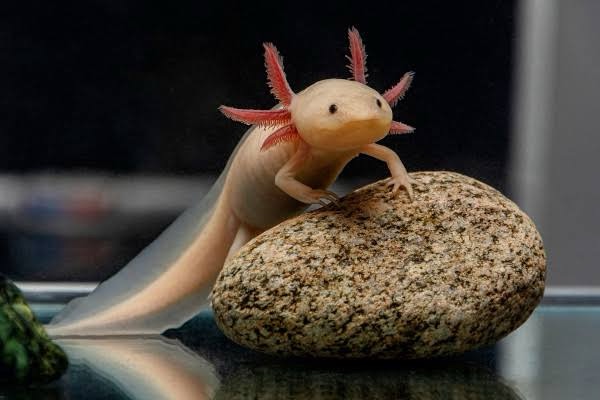
Upon observing the axolotl, we are immediately captivated by its unique appearance. With an elongated and juvenile body even into adulthood, this amphibian showcases a varied coloration that ranges from pearlescent to black, often found with pink or brownish tones. Its body is adorned with three pairs of external gills that extend like feathers beside its head, allowing it to breathe underwater.
Axolotls inhabit the canals of Xochimilco, a network of waters that has been vital for their survival to this day. These waters accommodate their behavioral preferences, swimming slowly and gracefully along the bottom, where they feed on small crustaceans, worms, and other aquatic invertebrates.
The axolotl’s greatest ability is undoubtedly its **extraordinary regeneration** capacity. This fascinating attribute allows it to regenerate not only limbs but also parts of organs, the spinal cord, and even the brain. Such adaptations not only amaze scientists but also illuminate pathways for regenerative medicine. The regeneration is so efficient that wounds and amputations seem to disappear without a trace, a skill uncommon in most organisms.
Physically, the axolotl retains its neotenic phase, keeping larval characteristics throughout its life, such as its external gills. Fully adapting to an aquatic life, they rarely metamorphose into their terrestrial counterpart, the salamander. This rarity sets them apart, making them a fascinating icon among amphibians.
The axolotl is undoubtedly one of the jewels of the animal kingdom, a reflection of nature’s evolutionary diversity. For more on the wonders of aquatic life, the bat illustrates another incredible evolutionary adaptation.
Natural Habitat and Distribution
In the enigmatic and aquatic world of the Xochimilco canals, the axolotl finds its natural home. These canals, a vast system of lakes and swamps south of Mexico City, are one of the last strongholds of this extraordinary amphibian. Here, in shallow and calm waters, densely populated by aquatic plants, axolotls thrive in environments with little current and high concentrations of submerged vegetation.
These ancestral lakes provide axolotls not only shelter but also a rich abundance of food. They feed on small fish, benthic organisms, and insect larvae, all abundant in this unique ecosystem. The thick vegetation also serves as a hiding place, protecting them from predators and direct sunlight, essential for their nocturnal behavior.
The Xochimilco canals, listed as a UNESCO World Heritage Site, besides being a sanctuary for various endemic species, face significant environmental challenges. Urbanization and pollution impose a growing threat to the delicate balance of these ancestral waters. Despite this, the axolotl’s adaptability to its environment has granted it niches of persistence, highlighting its resilience in the face of adversity.
The many secrets that the Xochimilco canals hold are a testament to the delicate balance between life and uncertainty in nature. Understanding these habitats can further unveil how axolotls not only survive but thrive. Their presence is a reminder of the rich biodiversity that emerges from unique environments and how these complex systems sustain life in unimaginable forms.
The Regeneration of the Axolotl
The axolotl, a fascinating creature, holds within it a nearly magical natural secret: its impressive regenerative ability. This small Mexican amphibian can rebuild entire limbs, parts of the heart, and even parts of the brain with an efficacy that leaves scientists in awe. While most living beings heal, the axolotl restores. This process involves the activation of stem cells called ‘blastemas,’ which resemble embryonic cells in their ability to transform into various types of tissues. As science advances, researchers are investigating how the axolotl manages to avoid scars, which typically hinder regeneration in other animals.
Studying the axolotl has provided scientists with valuable insights into the potential for regeneration in other animals. The genetics of the axolotl offer precious clues that could revolutionize treatments for injuries and human diseases. Although we are still far from applying these discoveries practically, the fascination and promise that this research carries are undeniable. Understanding the genes involved in the regeneration process could open new avenues for understanding degenerative diseases, among other ailments.
Nature has its champions, like the axolotl, who inspire us with their ability to reinvent themselves. Comparable to the extreme resilience of other beings, such as the tardigrade, the axolotl teaches us about the complexity and unexplored potential of regenerative biology. As we face environmental and health challenges, delving into the regenerative potential of the axolotl may be a window into the future of medicine and biodiversity conservation.
Threats to the Axolotl’s Survival
The axolotl, a fascinating inhabitant of the shallow canals of Xochimilco, faces considerable dangers that threaten its existence. Habitat loss is perhaps the most devastating of these threats. The ancient canals, once vast and vibrant, are rapidly being converted into urban land. This small amphibian relies on these aquatic environments to survive, but rampant urbanization and water drainage have significantly reduced its natural habitat.
Moreover, water pollution from industrial and agricultural waste poses a serious risk to the axolotl’s health. Chemicals released into these canals alter water quality, making it unsuitable for these delicate creatures. Pollutants, such as heavy metals and pesticides, penetrate the ecosystem, further complicating the axolotl’s life. These substances have adverse effects, such as reducing survival rates and deforming regenerated limbs.
Invasive species are another factor complicating the axolotl’s survival. Species like tilapia and perch have been introduced into the canals and compete for food and space, in addition to being voracious predators of axolotl eggs. This competition drastically reduces the species’ chances of survival.
These accumulated threats have resulted in a drastic decline in the axolotl population, bringing them to the brink of extinction in the wild. While conservation efforts are underway, as we will discuss in the next chapter, it is essential to remember that protecting this amphibian is not just a matter of preserving a charming species. The axolotl is crucial for maintaining a healthy and resilient ecosystem.
Conservation and Future of the Axolotl
In the vast tapestry of life, few beings are as astonishing as the axolotl. Confronted with increasing challenges, this singular amphibian now depends on our conservation efforts. The axolotl’s natural habitat, the complex system of lakes and canals in Xochimilco, has faced intense pressure due to urbanization and pollution.
Local and international initiatives are seeking to reverse this scenario. Conservation projects are working to restore the lakes by removing pollutants and reintroducing native plants. Such efforts aim to recreate a suitable environment for the axolotl’s survival. In parallel, research centers have dedicated themselves to captive breeding, ensuring that the species does not disappear completely.
But why does an amphibian with such a restricted habitat deserve attention? The answer lies in its unique ability: regeneration. Axolotls possess the remarkable capacity to regenerate limbs, organs, and even parts of their brains. This property has fascinated scientists, providing valuable insights for medical research and regenerative therapies.
Axolotls also play a crucial role in the local food chain, controlling populations of insects and small aquatic animals. Their presence indicates a healthy ecosystem, contributing to biodiversity. Losing them could result in unpredictable consequences for the ecological balance of the region.
Protecting the axolotl aligns with broader initiatives for **biodiversity preservation**. The importance of the axolotl transcends its habitat; it symbolizes the interconnectedness between environmental conservation and scientific advancement. For more examples of conservation initiatives, see the article on the rufous-tailed jacamar, the fascinating bird of Brazilian waters.
Conclusions…
The axolotl, with its fascinating regenerative ability and unique appearance, deserves our attention and protection. Conserving these creatures is vital for maintaining biodiversity and studying their incredible adaptations. Thus, we continue to admire and learn from this remarkable amphibian and its habitat.
Did you know?
What is the origin of the axolotl? The axolotl is native to the lakes and canals of Xochimilco, Mexico, and has a rich history linked to Mexican culture.
Why is the axolotl known for its regeneration? This amphibian is famous for its ability to regenerate limbs, organs, and even parts of the heart, making it a fascinating subject of study in biology.
What are the threats to the axolotl? The main threats include habitat loss due to urbanization, pollution, and invasive predators, which put the species at risk.
How does the axolotl reproduce? It reproduces through external fertilization, with the female laying eggs that are subsequently fertilized by the male, resulting in aquatic larvae.
What is the role of the axolotl in the ecosystem? As both predator and prey, the axolotl plays an important role in the food chain of its aquatic habitat.