The Enigmatic Bornean Frog
The Bornean Frog is a fascinating and enigmatic species that stands out for its extraordinary ability to breathe entirely through its skin. This peculiarity adapts this amphibian to a unique aquatic habitat, where it resides in the rivers of Borneo. Let’s explore the biology, habitat, and threats surrounding this incredible species.
Description of the Bornean Frog
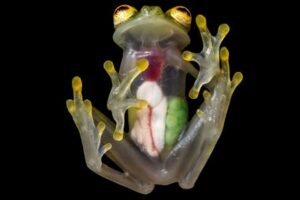
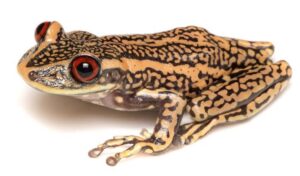
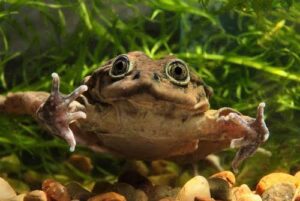
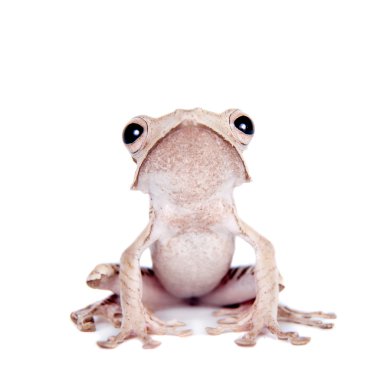
The Bornean Frog, one of the most intriguing species of anurans, possesses characteristics that make it unique. Its body is robust, averaging a length of 5 to 10 centimeters. These dimensions are adapted for aquatic life in the rivers of Borneo. The colors range from deep green to brown, with dark spots that serve as camouflage in the humid environment. This coloration is not just aesthetic; it is a vital adaptation that helps in defense against predators.
The Bornean Frog’s legs are wide and webbed, ideal for swimming. These membranes between the toes provide efficient propulsion in the water, allowing the frog to move quickly, whether to escape predators or to capture prey. Its large, bulging eyes offer a wide field of vision, essential for detecting movements from a distance, both in water and on land.
Another notable adaptation is its skin, which secretes a mucus that maintains moisture and protects against pathogens. This moist skin is crucial for cutaneous respiration, especially in aquatic environments. The texture of the skin can vary, from smooth to slightly rough, depending on the habitat, reflecting the constant environmental changes this species faces.
Moreover, this morphology allows the Bornean Frog to be an effective predator. It primarily feeds on insects and small invertebrates. This feeding efficiency is fundamental for maintaining its habitat, balancing the ecosystem where it lives. For more information about locations that host this rich biodiversity, consider exploring what aquatic zones can offer to the numerous species inhabiting the region, as discussed in this interesting post about aquatic birds.
Habitat and Behavior
The Bornean Frog, with its curious and attractive appearance, is an exclusive inhabitant of the tropical forests of Borneo. This amphibian prefers humid environments, living around rivers, lakes, and swamps. The banks of these bodies of water are the ideal location for its reproduction and feeding. The dense forests provide shelter and protection against predators and adverse climatic conditions. Within this habitat, the Bornean Frog adapts to the seasonal variation of rainfall, taking advantage of flooding periods to expand its foraging territory.
In terms of behavior, this frog is nocturnal, primarily active at night. During the day, it prefers to hide in fallen logs and under large leaves, where moisture is preserved. Its camouflage skills make it difficult to detect, helping it avoid predators. When it comes to feeding, this frog is insectivorous, comprising a varied diet that includes insects, arachnids, and even small crustaceans, which it captures with its sticky and quick tongue.
The reproduction of the Bornean Frog is a fascinating spectacle. Males gather in wet areas and croak to attract females. After copulation, the eggs are deposited in the water, where they develop. This method of aquatic reproduction ensures that the tadpoles remain in the ideal environment for their initial growth. Thus, the Bornean Frog demonstrates an impressive interaction with its habitat, always seeking to ensure its survival and the continuity of the species. For more information about aquatic life, check out this article on aquatic birds.
Respiration Mechanism
The Bornean Frog, a unique creature, possesses a fascinating respiration mechanism. This amphibian does not have lungs like most of its relatives. Instead, it breathes through its skin, a process known as cutaneous respiration. This adaptation is especially important in its aquatic habitat. The frog’s skin is highly vascularized, allowing for efficient gas exchange. Oxygen dissolves in the mucous layer of the skin and enters directly into the bloodstream through fine capillaries. As it moves through the water, cutaneous respiration becomes its primary means of obtaining oxygen.
The Bornean Frog is highly adaptable to different environmental conditions. During dry periods, it can enter a state of dormancy. In this state, it reduces its metabolic activity. Respiration continues, but at a much slower rate, conserving oxygen. This is crucial in the struggle for survival in a constantly changing habitat.
Furthermore, the skin not only allows for respiration but also acts as a barrier. It can absorb water, helping the frog maintain hydration. This ability is vital in hot and dry environments, where evaporation is rapid. However, this sensitivity to pollution is a risk factor. Pollutants in the water can impair this respiration.
As the Bornean Frog navigates its aquatic habitat, its respiratory adaptations highlight the complexity of life in this ecosystem. For more details on surprising adaptations in nature, see this article on tardigrades, which also exhibit fascinating survival strategies.
Threats and Conservation
The Bornean Frog is an extraordinary creature but faces significant challenges. Among the main threats are habitat destruction, pollution, and emerging diseases. The rapid deforestation of Borneo’s forests, driven by palm cultivation and logging, drastically reduces the areas where these frogs can live and reproduce. This loss of habitat is not limited to a physical space; it affects the entire surrounding ecosystem. Without trees, many other species that depend on this habitat also suffer.
In addition to habitat loss, water and soil pollution is becoming an increasingly pressing concern. Chemicals resulting from improper agricultural practices seep into aquatic environments and the lands where the frogs are found. This compromises the health of the frogs and can lead to a decline in their populations.
Diseases are also a critical threat. Fungi and parasites that were previously absent in the regions where the Bornean Frog lives are now spreading. The introduction of invasive species can increase these infection rates.
Conservation initiatives are essential. It is necessary to implement protected areas and promote sustainable agricultural practices. Educating local communities about the importance of the Bornean Frog and its habitat is crucial. Habitat rehabilitation projects are also fundamental, allowing native flora and fauna to thrive again. For more information on conservation actions and strategies to protect endangered species, check out this article focusing on successful preservation initiatives.
Ecological Importance
The Bornean Frog plays a fundamental role in its ecosystem. As an amphibian, it occupies a crucial space in the food web. Frogs, including the Bornean Frog, are natural predators of insects. They help regulate the population of these small animals. This, in turn, affects other species and contributes to a healthy ecological balance.
Besides being predators, Bornean Frogs also serve as prey. They are a food source for birds, reptiles, and even mammals. Thus, their presence is vital for maintaining the dynamics between different living beings. Their extinction could result in an uncontrolled increase in insects and a decline in the fauna that depends on them for food.
This amphibian also plays a crucial role in environmental health. The presence of frogs is an indicator of environmental quality. Healthy frog populations suggest a vibrant and balanced ecosystem. A decrease in their numbers can signal environmental problems, such as pollution or habitat loss. Thus, the Bornean Frog is a sentinel of the ecosystem’s state.
The biodiversity of Borneo is remarkable, and the Bornean Frog is one of its treasures. Its preservation is essential for maintaining the rich wildlife that inhabits the island. Protecting species like this contributes to the health of the planet. To learn more about the importance of biodiversity, check out this fascinating article on the connection between species in nature.
Conclusions…
The Bornean Frog is a remarkable example of evolutionary adaptation in nature, revealing the importance of conserving its habitats. By understanding its unique characteristics and the threats it faces, we can value and protect this singular species for future generations.
Did you know?
- What is the main characteristic of the Bornean Frog? Its main characteristic is cutaneous respiration, allowing it to live without lungs, adapting to aquatic environments.
- Where is the Bornean Frog found? This frog is found exclusively in rivers on the island of Borneo, in Southeast Asia.
- What threats does the Bornean Frog face? The main threats include habitat destruction due to deforestation and water pollution.
- Is the Bornean Frog an endangered animal? Yes, due to its environmental threats, the Bornean Frog is considered vulnerable and needs conservation efforts.
- What role does the Bornean Frog play in the ecosystem? This frog plays an important role in the food chain, helping to control insects and serving as food for predators.