Australian Kangaroo: The Living Symbol of Australia’s Unique Wildlife
The Australian kangaroo is not just a national symbol but also a unique representative of wildlife adapted to the diverse conditions of the continent, revealing the ingenuity of local wildlife.
The Origin and Evolution of the Kangaroo: A Million-Year Journey
As we leave behind discussions on global biological diversity in our previous chapter, we now dive into the origins of the kangaroo, this iconic creature of Australia. Emerging from the ancient forests of the supercontinent Gondwana, the kangaroo found itself in a transforming world after the fragmentation of this immense territory. Separated by expanding oceans, marsupials, including the ancestors of modern kangaroos, conquered a new land – what we now know as Australia.
In a predominantly isolated setting, with few predators and minimal competition from placental mammals, marsupials thrived. The kangaroo was not just adapting; it was flourishing, shaped by a constantly changing environment. The ancient forests gave way to vast deserts and savannas, pushing these animals into a series of remarkable evolutionary adaptations.
Essentially, the kangaroo’s ability to thrive in arid environments came not only from its physical capability to move efficiently but also from its adaptive diet and social behavior that allowed it to maximize the scarce availability of resources. These adaptations, due to prolonged isolation, gave rise to the diverse species we see today, from the robust red kangaroo to the more modest wallaby.
With the evolution of the kangaroo intertwined in the tapestry of the Australian ecosystem, they are not just survivors of past eras but also living symbols of nature’s extraordinary ability to resist and adapt. Bridging to the next chapter, where we will explore in detail the “Physical and Biological Characteristics: Nature’s Engineering“, kangaroos notably exemplify how deeply creatures can be shaped by the environments in which they live.
Physical and Biological Characteristics: Nature’s Engineering
The curiosity to discover how the Australian kangaroo fits so well to the challenges of wildlife leads us to admire the wise engineering of its anatomy. In this chapter, we will reveal the refined physical and biological adaptations that make this marsupial an exemplary example of adaptive evolution.
Powerful Structure of Legs and Tail
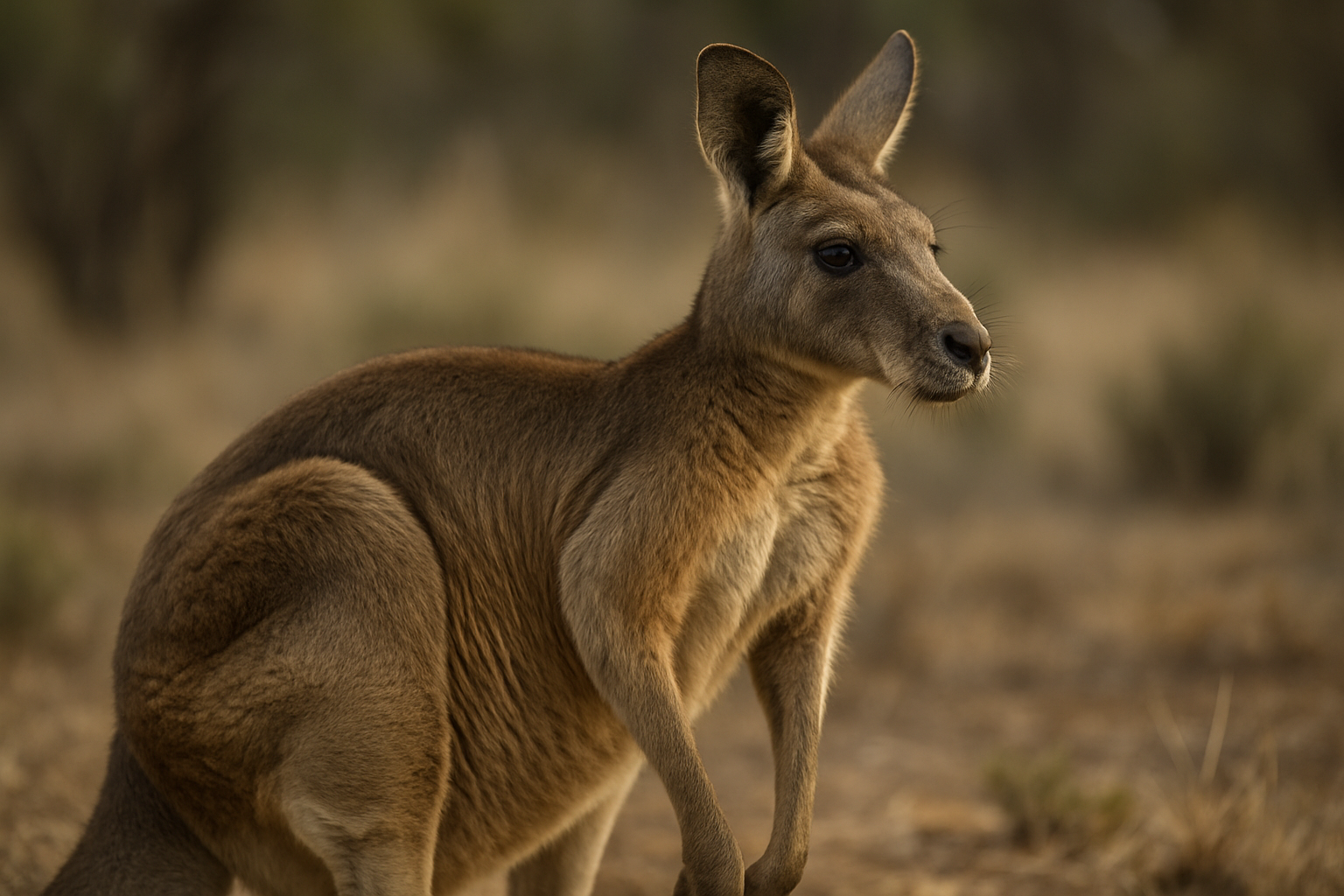
The kangaroo’s hind legs are true biomechanical works of art. Long and powerful, they are specialized for jumping, providing efficient and rapid locomotion, essential for escaping predators and covering long distances in search of food. The tail, in turn, serves as a vital counterbalance during running and as additional support when standing, functioning almost like a third leg. Together, the legs and tail allow the kangaroo to utilize an incredibly energy-efficient method of locomotion, as it employs elastic energy stored in the tendons while jumping.
marsupial Pouch: A Natural Incubator
The intriguing design of the marsupial pouch offers a safe refuge for the development of joeys in the critical early stages of life. This pouch, a distinctive feature of marsupials, protects the newborn joey, which develops externally as it clings to the mother’s nipples. This process sustains prolonged mothering, vital in the arid and unpredictable Australian territory, helping to moderate environmental impacts on infant mortality.
Observing the kangaroo in its natural environment reveals a wonderful synergy between form and function, ensuring its survival in the vast and challenging environments of Australia. The next section will explore how kangaroos adapt so well to a variety of habitats, from beaches to dry inland plains.
Habitat and Geographic Distribution: Dominance in the Australian Plains
Crossing the vastness of Australian lands, the kangaroo emerges not only as a quintessential icon but as a formidable adapter to the challenging climatic and geographical aspects of this vast continent. These marsupials are predominantly found in broad pastures and semi-arid plains, where the scarcity of natural obstacles favors their quick mobility and efficiency in escaping predators. These open areas not only provide the necessary resources for their sustenance but also play a crucial role in the local ecological balance. The kangaroo’s preference for semi-arid regions and pastures is intrinsically linked to its ability to thrive in low-humidity environments, where few would be so successful. Their presence in these habitats, in response to climatic variations, attests to their extraordinary adaptability. The interaction of the kangaroo with its habitat is a brilliant example of coexistence and environmental management. The way they influence vegetation, promoting the growth of low plants through their feeding, helps maintain a healthy balance in vegetation and, consequently, supports various other species within the food chain. Moreover, they play a vital role in seed dispersal, which is essential for plant regeneration and maintaining local biodiversity. The kangaroo’s ability to adjust its diet and behaviors in response to extreme weather illustrates its resilience. At the heart of these survival strategies is its ability to conserve energy during periods of excessive heat and find hidden water in isolated puddles or through the consumption of succulent plants. Regarding interaction in the food chain, kangaroos not only shape ecosystems through their diets but also through their physical presence, modulating the distribution and abundance of smaller animals and their predators. This reinforces the complexity of these interactions and highlights the kangaroo as a key element in the Australian ecosystem. As we move to the next chapter, we will explore ‘The Kangaroo in Australian Culture and Symbolism: Much More Than an Icon’, where the cultural and symbolic importance of this fascinating animal will be dissected, offering a deeper perspective on its role beyond the confines of nature.
The Kangaroo in Australian Culture and Symbolism: Much More Than an Icon
The kangaroo is not just an animal; it has become a powerful symbol of Australian identity. On Australian banknotes, in the emblem of the cricket team, and in countless tourism events, the distinctive shape of the kangaroo is immediately recognized around the world. Another charismatic animal, the koala, often shares the spotlight as an Australian icon, but it is the kangaroo that occupies a more prominent space in culture and national representation.
The relationship between the koala and the kangaroo goes beyond symbolic representation, reflecting a unique biodiversity that is vital to Australian national identity. The kangaroo has been incorporated into multiple aspects of Australian life due to its considerable impact on wildlife-related tourism. Annually, millions of tourists are drawn to Australia, motivated by the chance to see these remarkable marsupials in their natural habitat. This tourism generates significant revenue and helps sustain many local communities and wildlife conservation.
The kangaroo strengthens the sense of national unity and the dissemination of the rich tapestry of Australian fauna to a global audience. Beyond its economic value, it evokes a deep sense of belonging and pride in many Australians. As we prepare the ground for a study on kangaroo preservation, it is imperative to reflect on how these animals not only define the global image of Australia but also serve as vital symbols of its ongoing struggle for conservation. We carefully remember that protecting these symbols is preserving a key part of the very soul of Australia and our planet.
Conservation and Fascinating Facts: Protecting a Symbol of Nature
Surrounded by the vast and varied habitats of Australia, the kangaroo emerges not only as a national icon but also as a key to the vitality of the continent’s delicate ecosystems. These majestic marsupials, however, face a constant battle for survival, confronting threats from habitat loss and increasing human interference. Protected areas and strict laws have been established to safeguard these creatures, increasingly pressured by urban expansion and agricultural practices.
Kangaroos exhibit an intriguing social complexity, tending to form groups called ‘mobs’. This social structure not only provides security against predators but also establishes a fascinating communication system among them. Interestingly, kangaroos use body movements and vocalizations to convey messages within the group, from danger alerts to signals during play among the young. In terms of diet, kangaroos are herbivores, primarily consuming grasses and leaves, adapted to extract the maximum nutrients from foods often scarce in their arid environments.
It is crucial that each of us takes an active role in the preservation of kangaroos and, by extension, Australian ecosystems. Through education and support for conservation organizations, we can help ensure that future generations can also marvel at these incredible animals. Encouraging a more compassionate approach to human interaction with wildlife is a practical step we can take to maintain this remarkable species. As nature enthusiasts, it is our duty not only to learn but also to share the fascination that these magnificent beings evoke.
Conclusions…
The Australian kangaroo represents much more than a national symbol; it embodies the uniqueness and richness of Australian fauna. Its evolution and physiological adaptations demonstrate nature’s incredible ingenuity in shaping itself to the challenges of arid and varied environments. Moreover, its ecological importance is fundamental to maintaining the balance of local ecosystems, influencing everything from vegetation to the food chain. Culturally, the kangaroo is an icon that reinforces the identity and tourism of the country, highlighting the deep connection between fauna and Australian culture. Preserving this species means valuing an entire natural and symbolic legacy. Our commitment is to bring a different perspective on flora and fauna, revealing curious and often unbelievable details. Nature is not just beautiful – it is ingenious, mysterious, and, above all, full of secrets waiting to be discovered. Here, we want not only to inform but also to inspire. We want to awaken the same enchantment we feel when seeing a firefly light up the night or hearing a frog mimic the sound of rain. Did you enjoy this post? Like, comment, and share so we can continue creating!
Did You Know?
What is an Australian kangaroo?
The Australian kangaroo is a typical marsupial of the Australian plains, known for its marsupial pouch and strong jumps.
What is the importance of the kangaroo to Australian fauna?
It plays a role in controlling vegetation, seed dispersal, and is a vital component of the native food chain.
What are the main physical characteristics of the Australian kangaroo?
It has strong hind legs for powerful jumps, a muscular tail for balance, and a marsupial pouch for the development of joeys.
Where do Australian kangaroos primarily live?
They primarily inhabit the plains and dry, semi-arid regions of inland Australia, as well as open coastal areas.
How have kangaroos adapted to the Australian environment?
They have developed efficient jumps to cover long distances and physiological adaptations that allow them to conserve water and tolerate heat.
What is the relationship between the kangaroo and other Australian symbols like the koala?
Both are iconic marsupials that represent the diversity of Australian fauna, symbolizing different habitats of the country.
Is the Australian kangaroo endangered?
Currently, it is not classified as endangered but faces risks due to habitat loss and human conflicts.
How can we help in the conservation of Australian kangaroos?
By supporting protected areas, promoting environmental awareness, and respecting regulations to preserve their natural habitats.