Wallace’s Flying Frog: The Acrobat of the Skies
Wallace’s Flying Frog, a marvel of nature, captivates with its unique abilities to glide among the trees of the tropical rainforest. This article explores its biology, fascinating behavior, and the challenges it faces in its natural habitat.
The Fascination of Wallace’s Flying Frog
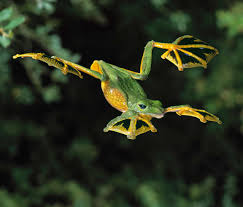
Wallace’s Flying Frog, with its slender body and vibrant colors, is a true spectacle of nature. These amphibians possess skin of a bright lime green, speckled with bluish and yellow spots. This coloration is not only a delight to the eyes but also plays a crucial role in camouflage, helping them blend into the arboreal environment they inhabit. Their large, expressive eyes provide sharp vision, essential for detecting predators and prey. The skin membranes that stretch between their fingers are a unique feature. These wing-like structures are fundamental to their gliding ability. In the forest canopy, where space is limited and dangers are frequent, Wallace’s Flying Frog uses these membranes to descend from tree to tree, conserving energy and avoiding predators. Their habitat, located in the dense tropical forests of Southeast Asia, offers a safe refuge and an abundance of insects for feeding. At night, the unique architecture of their body and their gliding ability transform the frog into a true artist of the skies. By jumping from a considerable height, Wallace’s Flying Frog takes advantage of the air resistance generated by its membranes, making each movement appear as a delicate choreography. Thus, it manifests as a symbol of adaptation and beauty in global biodiversity. To learn more about fascinating animals and their adaptations, check out the article on the jumping spider.
The Art of Gliding
Wallace’s Flying Frog, with its vibrant colors, is a true symbol of life in the treetops. This small wonder of nature not only displays beauty but also an extraordinary skill: gliding. When launching from a branch, its lateral membranes expand like wings, capturing air and creating lift. This adaptation allows it to cover considerable distances while gliding between trees. The gliding technique is not just a display of dexterity but a survival strategy. By avoiding the ground, which is teeming with predators, the frog maximizes its chances of escape. The membranes act as a control mechanism, allowing it to maneuver with precision, adjusting its trajectory in real time. The ability to glide is also advantageous in the search for new habitats for reproduction and feeding. Moreover, the arboreal habitat offers an abundance of insects, which are the primary food source for this species. By moving quickly from tree to tree, the frog increases its chances of finding prey. Gliding enables it to avoid dangerous ground, where predators like snakes and birds of prey may be lurking. This admirable aerial acrobatics makes Wallace’s Flying Frog a true acrobat of the skies. Therefore, its membranes are not just an evolutionary curiosity but represent the essence of survival in a complex ecosystem. To better understand animal adaptations in the environment, check out this article on jumping spiders, which also possess impressive skills for capturing their prey.
Behavior and Feeding
The strawberry poison dart frog exhibits fascinating behavior, especially in its quest for food. These small creatures are voracious predators, primarily dedicated to capturing insects. Their diet mainly consists of ants, small beetles, and flies. This dietary selection is not accidental but crucial for obtaining their characteristic toxin. The frogs absorb specific toxins present in the insects they consume, which subsequently accumulate in their tissues. Thus, what initially may seem like a simple meal reveals itself as a vital component of their chemical defense. As part of their social behavior, strawberry poison dart frogs are known for their territoriality. Males, in particular, vigorously defend their breeding territories, vocalizing loud calls to attract females and ward off rivals. This ritual, filled with color and sound, is a fundamental part of their reproduction. Additionally, the egg incubation behavior is fascinating. Females typically lay eggs in elevated locations, such as suspended leaves, where the tadpoles can fall into safe waters. This minimizes predation and optimizes the survival of the offspring. Even among frogs, notable social interaction behaviors are observed. They may group together at certain times of the year, especially during the breeding season. These behaviors are not only key to survival but also to the perpetuation of the species. For a detailed analysis of how insects influence the diet and toxin of this species, it is interesting to check this link.
Survival Challenges
Wallace’s Flying Frog, one of the wonders of biodiversity, faces significant challenges that threaten its existence. The primary challenge is habitat loss. The tropical forests, where this species typically takes refuge, are being devastated at an alarming rate. Unchecked logging and agriculture are among the most impactful causes. Vast green areas are turning into monocultures, eliminating not only the frog but countless species that depend on this rich and diverse ecosystem. Climate change also plays a crucial role in this narrative. Rising temperatures and changes in rainfall patterns directly affect other habitats. Flying frogs are sensitive to these changes, as they depend on specific climatic conditions for reproduction. Furthermore, water and soil pollution adds another layer of concern. Chemicals and pesticides have a devastating impact on the fauna living in these regions, with Wallace’s Flying Frog not being an exception. Toxins affect the health and reproduction of the species. Habitat fragmentation, resulting from urbanization, causes populations to become isolated. This reduces genetic diversity, making the species more vulnerable to diseases and local extinctions. In summary, Wallace’s Flying Frog is a symbol of the weaknesses of our ecosystems. Reducing these threats is crucial not only for its survival but for the health of tropical forests as a whole. To better understand the relationship between different species and their habitats, one can explore the role of each being in nature.
Conservation and Future
The conservation of Wallace’s Flying Frog is vital for the health of tropical forests. These ecosystems are rich in biodiversity, and the presence of species like this frog plays a crucial role in environmental balance. Conservation efforts include preserving its natural habitat, which is in extreme danger due to deforestation and human exploitation. Environmental organizations work tirelessly to ensure that tropical forests remain protected, implementing sustainable practices for the use of natural resources. An important approach is the creation of protected areas. These reserves not only preserve the frog’s habitat but also that of countless other species that share this space. Scientific research is equally essential. Studies on the behavior and ecology of Wallace’s Flying Frog help to better understand its needs and threats. Education and awareness of the local community are also key elements in conservation. Encouraging the population to value and protect biodiversity is fundamental. When communities understand the direct importance these ecosystems have for their lives, they become allies in protecting Wallace’s Flying Frog and its home, the tropical forests. Moreover, celebrating biodiversity through ecotourism can bring economic benefits to local communities. This creates an incentive for conservation rather than degradation. Maintaining biodiversity is essential, not only for the survival of Wallace’s Flying Frog but also for the sustainable future of our planet. To learn more about the importance of fauna in ecosystems, visit this link.
Conclusions…
Wallace’s Flying Frog, with its unique gliding abilities, represents the beauty and complexity of life in tropical forests. Conserving its habitat is vital to ensure we can continue to admire this acrobat of the skies.
Did You Know?
What is Wallace’s Flying Frog?
Wallace’s Flying Frog is an arboreal frog species from Southeast Asia, known for its thin membranes between its fingers that allow it to glide between trees.
How does Wallace’s Flying Frog glide?
It uses the membranes between its toes to create a drag surface, allowing it to glide smoothly through the air and move between branches.
What is the natural habitat of Wallace’s Flying Frog?
This frog inhabits the tropical forests of Southeast Asia, where it finds a rich vegetation environment and a climate favorable to its survival.
Why is Wallace’s Flying Frog threatened?
The frog faces threats such as habitat destruction due to deforestation and climate change, which affect its way of life.
How can we help protect Wallace’s Flying Frog?
Supporting conservation initiatives, promoting sustainable forest management, and raising awareness about the importance of biodiversity are effective ways to help.