Mantis Shrimp: The Crustacean with Powerful Claws and Unique Vision
The mantis shrimp is a crustacean that defies the laws of nature with its powerful claws and unique trinocular vision. This intriguing creature, a protagonist in marine ecosystems, deserves a deeper exploration.
Physical Characteristics of the Mantis Shrimp
Imagine yourself in the murky depths of the ocean, where a small predator is capable of capturing its prey with impressive speed. This is the essence of the mantis shrimp, which, in addition to its incredible hunting ability, displays physical characteristics as fascinating as its intelligence. The powerful claws that define this crustacean are much more than hunting tools; they are true precision weapons.
The Powerful Claws
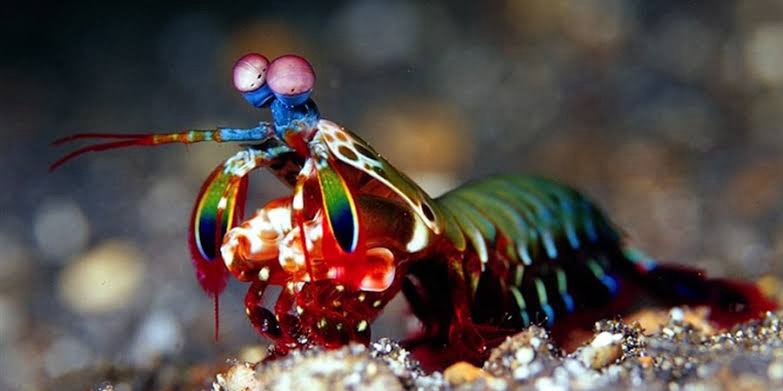
The claws of the mantis shrimp are a masterpiece of evolution. It possesses one claw larger than the other, and this difference is not merely aesthetic. This claw can deliver a strike that resembles a gunshot. When it closes rapidly, it generates a shockwave that can stun or even disintegrate small fish, facilitating capture. It is fascinating to observe how the strength and precision of this claw are fundamental to its survival.
The Unique Vision
But it is not just the strength that makes this shrimp extraordinary. Its eyes are equally impressive. The mantis shrimp possesses one of the most advanced visual systems in the animal kingdom. Its compound eyes allow for exceptional motion perception and vision across a wide range of colors. Furthermore, the positioning of its eyes, which can move independently of one another, provides a 360-degree view, an undeniable advantage in detecting predators. This combination of hunting skill and visual perception captivates any observer.
Thus, when contemplating this magnificent crustacean, it is easy to understand why each physical characteristic is fundamental to its survival. Evolution has shaped the mantis shrimp into a truly special being, whose claws and eyes create a perfect synergy for life in the depths of the sea. Now, let us move on to the next chapter, where we will explore the intriguing social behavior and habitats that shape the life of this fascinating crustacean.
Behavior and Habitat
As we explore the fascinating world of the mantis shrimp, we encounter a creature whose social complexity and habitat preferences are as notable as its powerful claws. This extremely intelligent crustacean is not only an efficient predator but also a vital component of its ecosystem.
Social Behavior
Mantis shrimps exhibit intriguing social behaviors. They often live in colonies, where communication plays a fundamental role. Among group members, visual signals and subtle touches on the legs are used to maintain order and establish hierarchies. Additionally, these social interactions are essential for reproduction, as the display of vibrant colors and fascinating dances attract potential mates. The strange ability to attract attention through impressive colors reflects a social character that cannot be underestimated.
Types of Habitat
The mantis shrimp prefers specific habitats, such as coral reefs and fine sandy areas. These regions not only provide shelter but also create a conducive environment for hunting. The crevices and holes between the rocks are ideal spots to ambush prey. It is in these bloody marine stages that the mantis shrimp captures its food while protecting itself from predators. Therefore, understanding the habitat and behavior of this crustacean is essential for species conservation and the preservation of marine ecosystems. With this in mind, we move on to an equally fascinating aspect of its life: diet and feeding, where we will explore how this vibrant crustacean captures its prey in the vastness of the ocean.
Diet and Feeding
As a true predator of the underwater world, the mantis shrimp, with its powerful claws and unique vision, has a diet that is as fascinating as it is efficient. Its feeding mode is a masterful strategy that reveals the complexity of marine life. These impressive crustaceans are known for their ability to hunt smaller prey, using an attack technique that is truly remarkable.
The Nature of the Hunter
This crustacean primarily feeds on small fish, mollusks, and other invertebrates. Equipped with claws that can reach speeds of up to 50 mph, it is capable of capturing its prey with almost surgical precision. Moreover, the way it uses its claws reveals much about its adaptability. During the hunt, the mantis shrimp positions itself strategically, often camouflaged among the rocks or in the sand at the ocean floor. This cunning behavior increases its chances of success, as its prey do not even suspect the danger approaching.
Capture Techniques
When a prey is spotted, the mantis shrimp prepares for the attack, showcasing its impressive speed and strength. The attack is almost instantaneous, and its claws are not just weapons; they also serve as tools. After capturing the prey, it mutilates it or, in some cases, keeps it alive for a fresher meal. This approach not only ensures the intake of nutritious food but also reveals how its diet adapts to what the surrounding marine environment offers.
Thus, as we explore the diet and feeding of the mantis shrimp, we are invited to admire the beauty and complexity of ocean inhabitants. As we move forward, it will be intriguing to discover the ecological importance of this crustacean and how its existence contributes to the health of the oceans.
Ecological Importance
The trajectory of the mantis shrimp is marked by an extraordinary ecological role. This crustacean, with its phenomenal claws and impressive visual capacity, not only stands out as a predator but also as an essential element in the balance of the marine ecosystem. At its core, this animal is a population controller, playing a vital role that impacts various species around it.
Regulator of Ecosystems
Studies reveal that the mantis shrimp, through its predatory behavior, helps regulate populations of small organisms. Its quick and precise attacks ensure that diversity in the water remains uncompromised. Furthermore, it is food for a variety of predators, creating a complex food web. Therefore, through this cycle, it helps maintain the health of the oceans significantly.
Contribution to Biodiversity
Moreover, the presence of the mantis shrimp indicates the quality of the marine habitat. The absence of this crustacean in certain areas can be a sign of environmental imbalance. Its social behavior and ability to build burrows also provide shelter and protection to other species, contributing to biodiversity. It is evident that the preservation of this organism is essential, not only for its own survival but also for the well-being of the marine ecosystem.
Thus, as we explore the richness of underwater life, the complexities of nature reveal to us that even the smallest inhabitants, like the mantis shrimp, have an immense impact. Therefore, as we turn to recent scientific discoveries, we will better understand how this fascinating crustacean operates in harmony with its environment.
Recent Scientific Discoveries
Imagine an underwater world where a crustacean stands out for its unusual strength and adaptive vision. The mantis shrimp, this extraordinary creature of the depths, has attracted the attention of scientists seeking to unravel the secrets of its fascinating and complex biology.
Unmatched Visual Powers
Recent research has revealed that the mantis shrimp possesses one of the most sophisticated visions in the animal kingdom. Its eyes, composed of up to 16 different types of photoreceptor cells, allow it to see a range of colors that surpasses human perception. Furthermore, new investigations have integrated advanced imaging techniques, showing that these crustaceans can detect the polarization of light, a rare ability among marine creatures. This capacity not only enhances hunting but also aids them in social interactions and navigation in complex environments.
Claws of Lethal Power
In addition to its visual abilities, the claws of the mantis shrimp are the subject of fascinating studies. Recent laboratory tests have confirmed that its claws can break shells and even glass aquariums in fractions of a second, demonstrating an unusual strength. This is due to the unique structure of its muscles, which contract rapidly and concentrate energy in the strike. These discoveries not only help understand the evolution of this predator but also have implications for materials engineering, where scientists seek to replicate such properties in human constructions.
These revelations about the mantis shrimp are not mere curiosities. They are intertwined with the understanding of marine life and the preservation of habitats. Connecting the past with the future, these discoveries reveal a fascinating window into the behavior and adaptation of species in the marine ecosystem. Thus, as we delve into its complexities, we can better understand not only these creatures but also the challenges faced in their habitats, paving the way for the next section on the evolution of the dogfish.
Conclusions…
The mantis shrimp, with its impressive claws and trinocular vision, not only survives but thrives in challenging seas. Its role in the marine ecosystem is fundamental, bringing balance and nature. Studying these crustaceans is vital for better understanding marine biodiversity and interspecies interactions.
Did You Know?
What is the mantis shrimp? It is a marine crustacean known for its powerful claws and trinocular vision.
What is the importance of the mantis shrimp in the ecosystem? This crustacean plays a crucial role in the food chain and the balance of the marine ecosystem.
How does the mantis shrimp communicate? They communicate through visual and behavioral signals, using their claws and colors.
What is the diet of the mantis shrimp? They are carnivorous, feeding on small marine animals, such as fish and other crustaceans.
Where is the mantis shrimp found? These crustaceans can be found in various tropical and subtropical regions around the world.
What are the claws of the mantis shrimp like? Their claws are extremely powerful and are used for defense and capturing prey.
What are the characteristics of the mantis shrimp’s vision? It has trinocular vision, allowing depth perception and a wide view of the environment.
How do humans benefit from the mantis shrimp? They are used in scientific research and can offer insights into marine ecology and biology.