The Fascinating Yeti Crab
The yeti crab, an intriguing creature from the depths of the Pacific Ocean, reveals surprising secrets. With its legs covered in white ‘hairs’ and fascinating habits, this crustacean has sparked the curiosity of scientists and adventurers alike. Let’s explore its biology, habitat, and the mysteries surrounding it.
Discovering the Yeti Crab
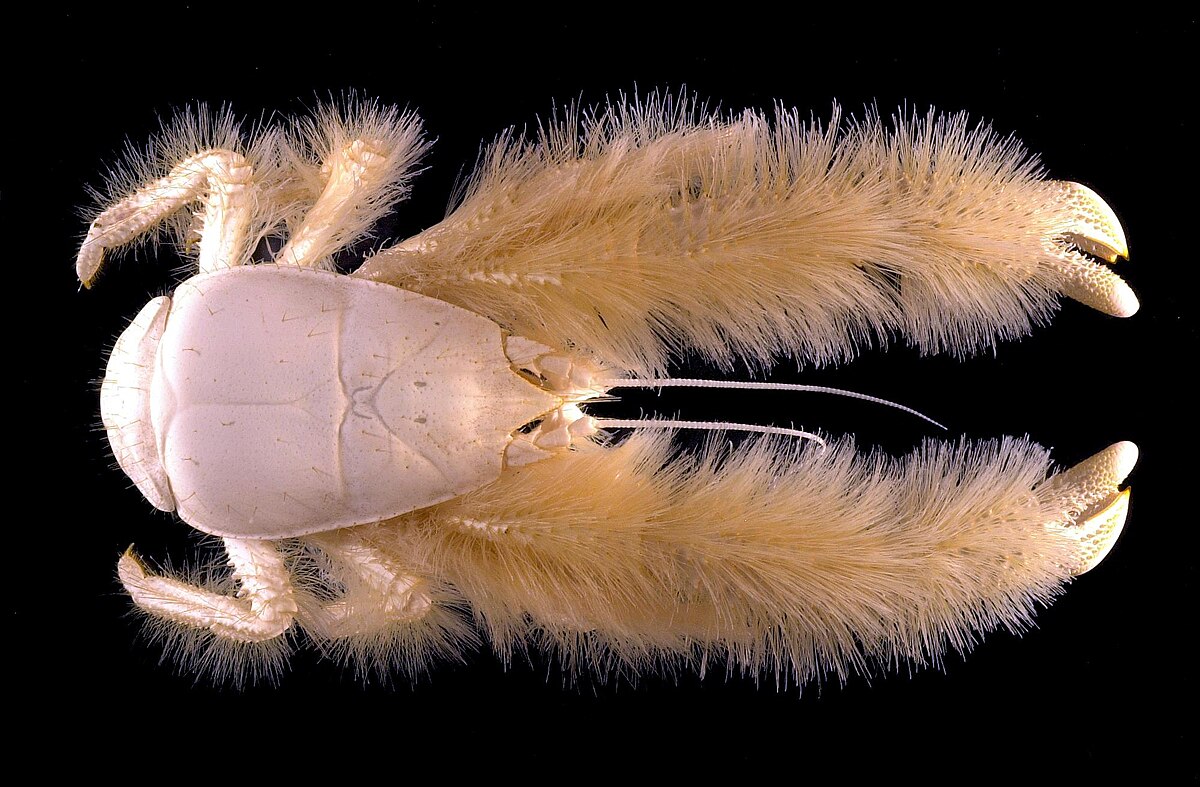
In 2005, scientists dove into the depths of the Pacific Ocean, near the underwater faults of Easter Island, and found a magnificent inhabitant of the deep: the yeti crab. This crustacean, with its peculiar appearance and ghostly look, quickly captivated the imagination of marine biologists and the public. Its pinkish-white body, covered in hairs reminiscent of a fur coat, contrasted dramatically with the dark and inhospitable environment around it.
The discovery of the yeti crab revealed biological characteristics adapted to survive in extreme conditions. At abyssal depths, where sunlight does not reach, it inhabits a world of icy temperatures and crushing pressures. Still, its most striking biological peculiarity lies not only in its appearance but in its behavioral adaptations.
The yeti crab occupies a unique position in the deep-sea ecosystem. It positions itself near hydrothermal vents, where superheated water emerges from the Earth’s crust. In this environment of heat and abundance of minerals, the yeti crab uses its hairy claws to cultivate bacteria that metabolize minerals, serving as a food source. This symbiosis with the environment, creatively and effectively utilizing the resources around it, is a testament to its evolutionary resilience.
Among its adaptive features, the ability to withstand drastically varying temperatures stands out. The conditions around hydrothermal vents change continuously, requiring this crustacean to exhibit remarkable thermal flexibility. Its unique biology continues to inspire studies on extreme adaptations, influencing our understanding of life in comparable environments, such as those described for tardigrades and other extremophiles.
The Strange Biology of the Yeti Crab
As we explore the hidden corners of the oceans, we encounter the intriguing yeti crab, a true marvel of biological adaptation. This crustacean, with its almost mythological appearance, boasts long ‘hairs’ on its pincers, which, at first glance, seem to leave a trail of mystery and admiration. These hairs are not merely decorative. They harbor colonies of symbiotic bacteria that convert chemical compounds from the environment into essential nutrients for the crab.
The morphology of the yeti crab is an ode to survival in extreme conditions. Its long pincers not only support bacteria that nourish it but also assist in capturing organic particles dispersed in the environment. The confluence of symbiotic and mechanical systems in a single creature illustrates the complexity and beauty of marine life.
Adaptation is a key word in the life of the yeti crab, living in an ecosystem formed by hydrothermal vents, where temperatures can vary drastically and pressure is overwhelming. In this hostile environment, the crab not only survives but also plays an essential role in the ecosystem. Its body serves as a support for symbionts, which, in turn, are an important nutrient source for other forms of life.
The interaction of the yeti crab with its environment still raises many questions for scientists and explorers. Just like the tardigrade, known for its resilience, the yeti crab symbolizes the extraordinary capacity for adaptation of life in the face of daunting conditions. Perhaps a glimpse into the enigma of life in the ocean depths.
The Habitat of the Yeti Crab
In the depths of the ocean, where sunlight does not penetrate, the yeti crab finds its home. The conditions, though extreme at first glance, become a refuge where few dare to wander. Located in the hydrothermal fields of the Pacific Ocean, this crustacean stands out for its appearance covered in white bristles, which are not mere ornamentation.
In these territories of absolute isolation, life becomes a battle for resources. The water temperature can vary drastically, contrasting with the incessant ice and the scorching heat expelled by the hydrothermal vents. These formations release sulfurous gases and minerals, which nourish colonies of extremophile bacteria. The yeti crab, clever in its pursuit, uses the bristles of its arms to ‘cultivate’ these bacteria, which serve as its main food source.
This ability to sustain bacterial symbioses becomes crucial. The communities around the vents are sparse, and the energy derived from the chemical reactions there is the only available source. The metabolism of the yeti crab adapts to these conditions, a testament to evolution that resonates against the depths. Influenced by such a habitat, its behavior is reserved. It avoids conflicts and conserves energy, allowing it to tolerate long periods of scarcity.
The depth of these ecosystems recalls other inhabitants of the deep sea, such as the squid, which dwells in distant corners of human imagination. Such areas, where the unknown prevails, invite us to question the mysteries that reside far below familiar waves.
Mysteries of the Depths
In the silent depths of the ocean, the yeti crab emerges as a peculiar figure, surrounded by unfathomable mysteries. The abyssal depths represent one of the last refuges of the unknown on our planet. Here, human haste barely touches the shaded vastness, and the true nature of many creatures still escapes our understanding.
The isolation of these abyssal areas makes research a monumental challenge. The crushing pressure and endless darkness demand advanced technology and ingenuity. Submarines and remotely operated vehicles are our windows into this strange and enigmatic world.
Finding the yeti crab under these conditions is already an achievement in itself. These crustaceans live near hydrothermal vents, a habitat that is a mystery in itself. Such vents harbor vibrant communities that survive in an environment where sunlight never penetrates. Here, life flourishes through chemosynthesis, a phenomenon that has intrigued scientists for decades.
Research in this submerged realm is often slow and challenging. Collecting data requires patience and resilience in the face of many technological setbacks. Rarely does nature reveal its secrets easily, especially in such unexplored landscapes.
Each discovery today, like the yeti crab, can change our perception of life on our planet. Understanding these ecosystems offers us precious insights into the resilience of life and extreme evolutionary adaptation. In a dark and icy continent, the yeti crab becomes a symbol of this resilience.
Our fascination with these creatures is not only due to their exotic appearance but also because of their untold stories and the lessons they carry. In this aspect, it is similar to the question ‘After all, is an orca a whale or a dolphin?’, a quest for understanding in murky areas of nature.
The Importance of Marine Conservation
The vastness of the oceans, with their mysterious depths, shares secrets that only creatures like the yeti crab can reveal. The study of these fascinating life forms highlights the importance of preserving our precious marine ecosystems. The discovery of these exotic species not only sharpens our curiosity but also reminds us of the delicate balance existing in vast oceanic habitats. The role of scientists is crucial here. They embark on expeditions to capture the essence of life in the depths, not only to catalog diversity but to understand how these unique life forms contribute to the environment they inhabit. Only with this knowledge can we formulate effective strategies to preserve the health of the oceans.
Conservation actions become essential in a world where exploration and pollution threaten marine life. Institutions and governments work together to establish protected areas and support in situ research, seeking to reduce human impact. Scientists, like those dedicated to the study of the yeti crab, become tireless advocates for this cause.
It is interesting to note how stories of creatures like the platypus remind us of the richness and complexity of nature. Just like the platypus, the yeti crab serves as an emblem for a broader struggle. Each discovery, each small victory in marine preservation, is a step towards ensuring that future generations can marvel not only at what remains but at oceans that thrive in diversity and vitality.
Environmental preservation, therefore, requires collective effort. It is not just about protection; it is about ensuring that we continue to learn from the wonders that the oceans hide, carrying forward lessons that these incredible ecosystems have to teach us. For information on another intriguing marine creature, check out the squids.
Conclusions…
The yeti crab is not just a curiosity from the ocean floor but a symbol of the richness of oceanic biodiversity. Its ‘hairs’ and peculiarities reveal how life adapts to extreme environments. Protecting these intriguing creatures is essential for the preservation of marine ecosystems.
Did you know?
What is a yeti crab?
The yeti crab is a species of crustacean discovered in 2005, known for its legs covered in white hairs that help in filtering food.
What is the strongest crab species?
The Hannah crab, found in Japan, is considered one of the strongest crab species due to its ability to lift up to 50 times its weight.
How long does a crab live?
The lifespan of crabs varies, but many can live between 5 to 50 years, depending on the species.
What is the name of the large crab?
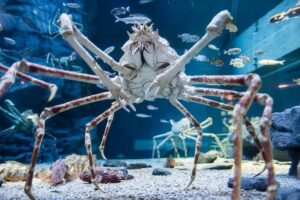
The Japanese giant crab is the largest crab in the world, with a wingspan that can reach up to 4 meters.
What is the rarest crab?
The yeti crab is one of the rarest crabs, found at extreme depths and little studied.
What is the largest crab in the world?
The Japanese giant crab is considered the largest in the world, reaching up to 4 meters in length.
Are there giant crabs in Brazil?
In Brazil, there are several species of crabs, but the Japanese giant crab is not found in its waters.