The Cordyceps Fungus: The Ant Zombifier
The Cordyceps fungus is a remarkable parasite that transforms the lives of insects, especially ants. Its ability to control its hosts alters the dynamics of the ecosystem.
The Life Cycle of Cordyceps
In the vast theater of nature, where every being plays a crucial role, emerges one of the most intriguing stories of parasitism: the life cycle of the Cordyceps fungus. This remarkable fungus, a true maestro of control, begins its journey in an extraordinary way, enveloping its victims in a deadly embrace. As it descends from the sky and lands on the ground, Cordyceps spores patiently await, active in an invisible world until an insect, usually an ant, interacts with its source of life.
Infection Stage
Once a spore is absorbed by its victim, the true spectacle of events begins. As soon as it enters the ant’s body, Cordyceps starts to multiply, sending thin filaments that spread throughout the insect’s system. Gradually, the fungus takes control of the ant’s mind, cunningly manipulating its actions. The ant, now under the nefarious influence of the parasite, climbs towards trees or plants, seeking the perfect location. This behavior, although bizarre, is essential for the fungus’s survival.
Fruiting and Release
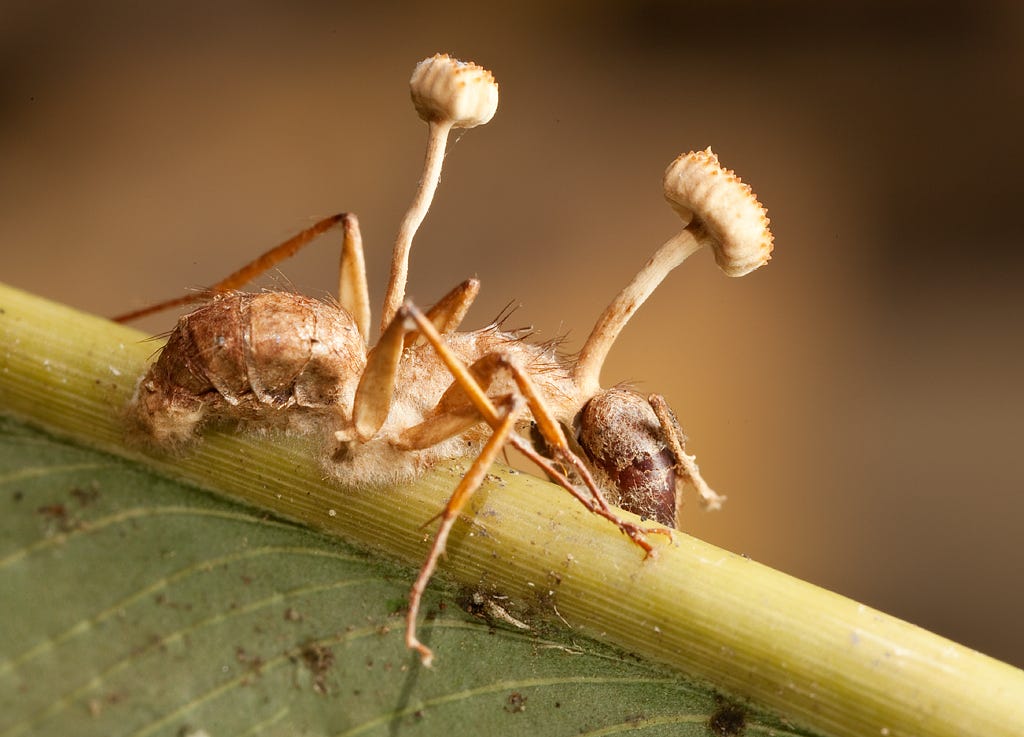
When the ant finds the ideal spot, the infection reaches its climax. The fungus consumes the ant from within, and in a dramatic act of creation, a fruiting body sprouts from its head. This body, filled with spores, ensures that the cycle begins anew, releasing new spores to infect more ants. This fascinating dance between the parasite and its host raises many questions about the intricate balance of life on Earth. However, the life cycle of Cordyceps is not just a story of domination; it is a powerful reminder of the complexity of interactions between species. This chapter merely scratches the surface of the true magic that resides in the combination of biology and behavior, which will be explored more deeply in the next segment, where we will examine the science behind the ‘zombifier.’
The Science Behind the ‘Zombifier’
Imagine a seemingly healthy insect walking towards its own destruction. This is the fascinating scenario unfolding in the realm of ants, where the Cordyceps fungus reveals itself as a dark maestro, manipulating the actions of its victims. This biological intrigue is not just a horror story, but a strategic spectacle between species, where the science behind this control is nothing short of extraordinary.
Contagion and Growth Mechanisms
The attack of Cordyceps begins with the infection of the ant, often after spores are inhaled while it forages for food. Once inside the ant’s body, the fungus releases chemicals that affect the nervous system. As a result, the signals the ant receives are distorted, leading it to climb plants in strategic locations. This change in behavior, as insidious as it is ingenious, is essential for the fungus’s success.
Chemical Compound Production
The chemical compounds produced by Cordyceps are a crucial part of this manipulation. For example, the production of neurotoxins is one of the methods used to influence the ant’s behavior. These compounds generally affect serotonin, a neurotransmitter that regulates mood and activity. This interaction not only alters the ant’s behavior but also ensures the ideal environment for the fungus’s growth, which, not satisfied, continues to develop until it bursts in an explosion of spores, ready to infect new ants. Thus, the cycle begins again. Cordyceps not only transforms its victims into zombies but also provides us with a remarkable example of how nature can operate in unexpected and fascinating ways. As we move forward, we will explore the ecological impact of this fungus, which, although a predator, also plays a crucial role in delicate ecological interactions.
Ecological Impact and Interactions
Nature is an intricate mosaic of interactions, where each piece plays a fundamental role in maintaining balance. The Cordyceps fungus, with its impressive ability to manipulate its prey, brings to light the complex interactions that define entire ecosystems. This microorganism, which takes over ants, is not just a predator but also a transformative agent of environments. By affecting insect populations, Cordyceps contributes to a delicate ecological balance.
Population Regulation
When Cordyceps infects an ant, it causes not only its death but also a significant change in group behavior. The infected insect ceases to fulfill its roles in the colony, which can result in increased diversity of other species, as fewer ants mean less competition for resources. Thus, the fungus acts as a regulator, maintaining the balance between predators and prey. This dynamic is vital for the health of the forest ecosystem, where biodiversity is constantly threatened by external pressures.
Symbiotic Interactions
In addition to its predatory interactions, Cordyceps also establishes complex relationships with other organisms. The ants, when manipulated by the fungus, inadvertently assist in the dissemination of spores. This relationship, although seemingly one-sided, highlights the interdependence in nature. By favoring the propagation of not just one species, Cordyceps influences the entire web of life in its habitat. These impacts are not limited to ants; they can affect other faunas, as observed in articles about the incredible nature of interspecies interactions. This biological wonder also ensures that biodiversity is preserved, even in the face of adversity. As noted, Cordyceps exemplifies the complexity of interactions in the natural world. For it is not just a destroyer but an influencer of the ecological balance of forests. Before we explore the medicinal properties of Cordyceps, it is essential to contemplate how it shapes ecosystems and interacts with their inhabitants.
The Medicinal Potential of Cordyceps
Amidst the misty forests of the mountains of the East, the Cordyceps fungus is not just a master of manipulation; it is also a remarkable medicinal prodigy. For centuries, this unique fungus has been used in traditional medicine, more than just a remedy, a symbol of strength and resilience in Asian culture.
Medicinal Properties of Cordyceps
Studies have revealed that Cordyceps contains a myriad of bioactive compounds that, when extracted, offer a variety of health benefits. Among them, cordycepin stands out, a substance that shows potential in increasing physical endurance and improving respiratory function. This discovery leads to the belief that the fungus can be a powerful ally against fatigue, enhancing athletic performance and muscle recovery. Furthermore, Cordyceps has demonstrated anti-inflammatory and antioxidant properties. Such characteristics have attracted the attention of researchers and scientists seeking to develop natural treatments for various ailments. Therefore, it is no surprise that the ancient philosophy of traditional medicine considers it an elixir to promote longevity and strengthen the immune system.
Cultural and Traditional Use
In Asia, the use of Cordyceps dates back centuries. It is often used in teas and elixirs that seek not only to heal but also to revitalize the spirit. Stories of its efficacy are passed down from generation to generation, reinforcing the respect that the fungus deserves. This tradition is not just cultural; it is rooted in empirical observations of its effectiveness.
Thus, exploring the medicinal potential of Cordyceps, we begin to perceive not only its practical applications but also how it can shape the future of fungal research. The next stage of our journey will lead us to discuss current and future trends in research on this extraordinary fungus.
The Future of Cordyceps Research
As interest in biodiversity and the unique chemistry of fungi grows, Cordyceps emerges as one of the most intriguing protagonists in this saga. Experts from various disciplines are increasingly focused on understanding not only the mechanisms by which this fungus manipulates its hosts but also its potential for medicine and biotechnology. This is, increasingly, a fertile field for research.
Advances in Biotechnology
Recent studies have revealed that Cordyceps contains bioactive compounds that have attracted the attention of scientists. For example, the ability of this fungus to produce therapeutic substances opens a range of possibilities in combating autoimmune diseases and strengthening the immune system. Moreover, research is also turning towards the application of fungi as agents to promote human health, stimulating a new field of studies on biomaterials.
Challenges and Opportunities
While the opportunities are immense, the challenges are also significant. The preservation of Cordyceps’ natural habitat faces constant risks due to overexploitation and climate change. Thus, conservation initiatives and sustainable cultivation become increasingly crucial. The future of Cordyceps research is not just a laboratory issue but an intersection of science, ethics, and environmental preservation. Therefore, as we venture into the complexities of Cordyceps, it is imperative to remain attentive to its repercussions and seize the lessons that nature offers us. This journey, filled with discoveries and challenges, promises not only to expand our understanding of life but also to enhance innovative solutions for health and the environment.
Conclusions…
In summary, the Cordyceps fungus represents a fascinating example of how nature can create complex and surprising interactions between organisms. Its ability to parasitize and manipulate ants not only exemplifies biological diversity but also highlights the interconnections that sustain ecosystems. Understanding these organisms can help us appreciate even more the richness of life on our planet and its multiple forms of adaptation and survival.
Did You Know?
What is the Cordyceps fungus?
It is a parasite that infects insects and other arthropods, controlling their behavior and often leading them to death.
How does Cordyceps zombify ants?
It releases chemicals that affect the nervous system of ants, leading them to act in ways that favor the dissemination of the fungus.
What are the most affected insect species?
Although it especially impacts ants, Cordyceps can infect a variety of arthropods, including some types of grasshoppers.
What are the effects of Cordyceps on the ecosystem?
In addition to controlling insect populations, it also contributes to decomposition and nutrient recycling in the soil.
Does Cordyceps have medicinal applications?
Yes, some types of Cordyceps are used in traditional medicine in various cultures, believed to have health benefits.
How do scientists study Cordyceps?
Researchers use various techniques, from field observations to genetic analyses, to better understand its biology and impacts.
Is Cordyceps dangerous to humans?
No, Cordyceps does not infect humans, but studying these fungi provides valuable insights into biology and environmental health.
Are there other fungi similar to Cordyceps?
Yes, there are other entomopathogenic fungi that also parasitize insects, but each has its peculiarities.