The jumping spider is the largest family of spiders, with over 6,380 species identified by science, according to the World Spider Catalog. The scientific name for the jumping spider family is Salticidae. With so many species, it’s no surprise that jumping spiders vary greatly in appearance, habitat, and preferred prey. The largest, Hyllus giganteus, can be up to 2.5 centimeters long, while smaller species, like the colorful Habronattus pyrrithrix, range from 5 to 8 millimeters in length. But what jumping spiders have in common is their impressive vision. These arachnids always have four pairs of eyes, including a large main pair facing forward that makes the spiders look cute and Muppet-like. These large eyes make jumping spiders stand out among spiders. They need to chase and jump to capture their prey… To do all this, they require truly exceptional vision. And their vision, depending on how you measure it, is the best for anything as small as they are.
What Are Jumping Spiders Like?
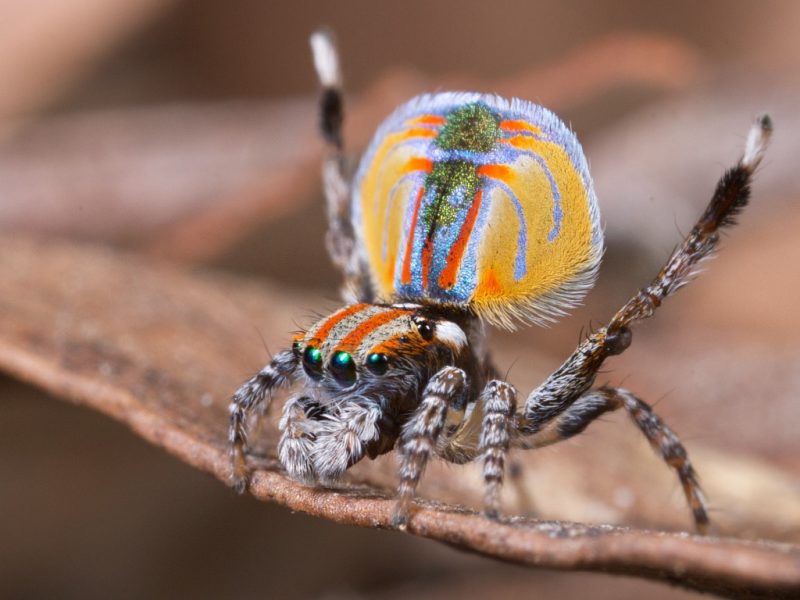
Jumping spiders are a diverse group. Some are drab, while others display a stunning variety of colors and patterns, from the blue, red, and yellow abdomen of the peacock spider (Maratus volans) to the black and white stripes of the zebra spider (Salticus scenicus). Saitis barbipes, a European species of jumping spider, boasts a red ‘band’ and similar stripes on its third pair of legs. Bagheera kiplingi, found in Central America, is striped with a brilliant emerald green. In many species, males are colorful, while females tend to be more drab. Jumping spiders have a few things in common. They are generally small, 12.7 mm or less in length. They are distinguishable by their distinctive ocular pattern of four pairs of eyes, where the large middle pair is close together at the front of the face. The face is quite flat.
How Good Is a Jumping Spider’s Vision?
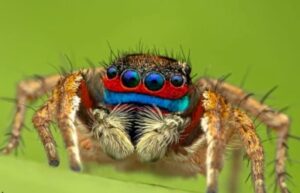
Jumping spider eyes are, in a word, incredible. Spiders, despite their tiny size, are better at seeing patterns than elephants. Their central pair of eyes, known as the principal eyes, are almost like a pair of tiny binoculars: they have a large outer lens and a smaller inner lens that magnifies the image from the outer lens and projects it onto the retina. Spiders are also unusual because they have muscles directly attached to their retinas. This means they can move their retinas up and down, side to side, focusing on different segments of the world without any hint of movement from the outside—a useful skill for a hunter. Meanwhile, the secondary pairs of eyes of the spiders are less acute but provide crucial peripheral vision. Most species of jumping spider can see ultraviolet, blue, and green light. Some species, however, have developed special tricks to expand their color vision. These tend to be the flashiest species, like the paradise jumping spiders (genus Habbernatus), which are often adorned in shades of red and orange. In some species, a random genetic mutation introduced an extra copy of the gene that produces the proteins allowing blue/green vision. This extra copy acquired mutations capable of detecting red and orange. Similar mutations allowed primates to develop color vision.
How Does Jumping Spider Vision Work?
Other jumping spiders have hacked color vision by developing pigments that sit in front of their blue/green color receptors. These pigments only allow red light wavelengths to pass through. Although the receptors are not very sensitive to these wavelengths of light, they react to the stimulus anyway, indicating to the spider that red or orange is present. Birds and reptiles often use this strategy to expand their color vision. Jumping spiders can also see depth in a ‘totally unusual’ way. According to a 2012 study, spiders use something called ‘depth via image defocus.’ Here’s how it works: the retinas of jumping spiders have four layers of photoreceptors. Since different colors of light have different wavelengths, each layer captures a different color of light in precise focus. In a jumping spider’s retina, the two bottom layers are filled with green color receptors. But the green light hitting one of those layers perfectly in focus will appear slightly out of focus in the other layer and vice versa. The 2012 study found that spiders use this difference in focus to detect depth.
Where Are Jumping Spiders Found?
Jumping spiders are found all over the world, except in Antarctica. They live in tropical forests, temperate forests, grasslands, savannas, and even deserts, where you might find the red-abdomen species Phidippus californicus hanging on a bush. They prefer outdoor habitats, but if they are indoors, they usually settle near a window or door, where there are more chances of capturing prey.
Do Jumping Spiders Really Jump?
Jumping spiders live up to their name. These spiders do not hunt by trapping prey in a web but instead chase their prey and then jump. Despite their tiny bodies, jumping spiders can leap up to 160 mm. Spiders often produce a bit of silk and set an ‘anchor’ similar to a thread before jumping, which can help stabilize their flight and protect them in case their landing is off. Jumping spiders usually jump to catch their prey, but sometimes they jump to escape danger.
What Do Jumping Spiders Eat?
Jumping spiders are carnivorous. They typically eat small insects and other spiders of their size or smaller. Some species punch above their weight, however. Many jumping spiders are good at capturing flies as prey, earning them the nickname ‘flying tigers.’ The regal jumping spider has been observed eating lizards and frogs two to three times its weight, according to research published in 2017 in the Journal of Arachnology. When it comes to diet, the strangest jumping spider is probably Bagheera kiplingi. This Central American spider specializes in eating the tips of acacia shrub leaves, making it a rare example of a spider that eats its greens.
How Do Jumping Spiders Reproduce?
Mating is a serious affair for jumping spiders. In many species, males display their bright colors and dance in elaborate courtship displays. The peacock spider, for example, raises its colorful abdomen and lifts a pair of legs in the air like a dancer. Research suggests that male spiders will perform these displays for any female jumping spider they encounter, regardless of species; this seems to be a way to maximize the chances of mating with the right female while keeping some distance to avoid being cannibalized by a hungry female of the wrong species. The display is not just about appearance. Research from 2005 showed that in some species of jumping spiders, the vibrations of the males’ dances are also crucial for maintaining female interest. Males drum on the ground. When a female shows interest, the male spider uses specialized appendages called pedipalps to transfer a packet of sperm and silk to a specialized pouch called an epigyne in the female. Females lay clutches of over 100 eggs, which they protect with a silk cocoon and guard until hatching. Some species mate multiple times with the female. And she chooses which sperm to use to fertilize her eggs after collecting several options. Others mate only once.
Are Jumping Spiders Venomous? Do They Bite?
Jumping spiders have venom that they use to subdue their insect and spider prey. They rarely bite humans, however, and will only do so if they are injured or crushed. Bites typically do not cause symptoms or may cause a temporary sting similar to a mosquito bite.
Source: Stephanie Pappas – Live Science