Exploring the Fascinating World of Echidnas
Echidnas, fascinating and peculiar creatures, inhabit remote regions of the world. Their habits, characteristics, and the intriguing way they live make these adorable animals worthy of exploration. Dive into this universe and uncover the secrets of echidnas, from their biology to their importance in the ecosystem.
The Origin of Echidnas
Echidnas, along with platypuses, belong to the monotremes, a group of mammals that defy conventional classifications. Their evolutionary history began millions of years ago, when the current characteristics of the Earth were still taking shape.
Unlike other mammals, echidnas lay eggs, a trait that dates back to their reptilian ancestors. This fact places them among the rare exceptions in the animal kingdom. In Australia, where life evolved in isolation, echidnas found a perfect niche. Their resilient bodies are well adapted to the varied environments of the continent.
While most mammals developed internal placentas, echidnas retained the egg-laying strategy. This trait has not made them less competitive; in fact, their survival illustrates the effectiveness of this adaptation. Unlike birds and reptiles, echidnas intensely care for their young after hatching, sheltering them in a protective pouch.
In the monotreme world, echidnas play a fundamental role. They are specialists in disturbing the soil, turning the ground while hunting ants and termites. This activity modifies the soil, promoting aeration and nutrient cycling. Thus, they not only survive but also contribute to the ecosystem around them.
This trait further distinguishes them from other mammals. The fascination sparked by echidnas lies not only in their appearance and habits but also in their monotreme relatives, highlighting the incredible diversity of mammalian evolution. Australia, with its geographic isolation, has given these creatures a unique chance to thrive and showcase the beauty of evolutionary adaptation.
Unique Physical Characteristics
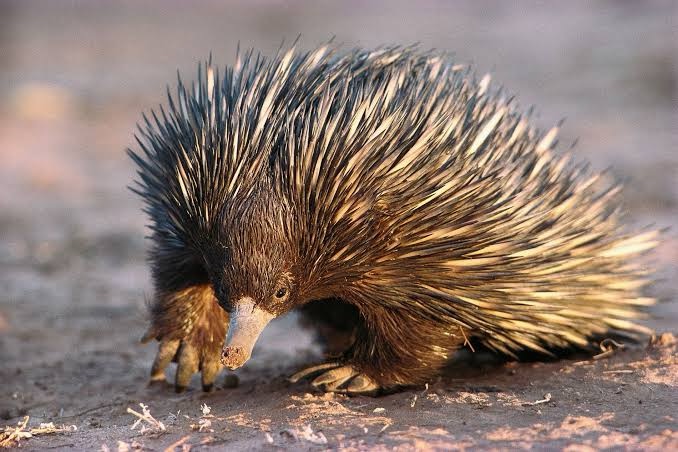
Echidnas are extraordinary creatures, endowed with physical characteristics that seem straight out of a fairy tale. Their spiny bodies, covered with stiff spines and thick fur, provide formidable defense against predators. These spines, similar to those of a porcupine, are actually modified hairs that can reach up to 6 centimeters in length. When threatened, echidnas curl into a ball, their spines acting as an impenetrable fortress.
The elongated snout of echidnas is perhaps one of their most fascinating features. Shaped like a beak, this snout functions as an efficient detector of ants and termites, their primary food source. Equipped with electroreceptors, the snout helps the echidna sense the electric field generated by the muscles of its small moving targets. This detection system is essential for their survival, allowing them to locate food beneath the ground or fallen tree bark with astonishing precision.
The legs of echidnas also deserve special mention. Strong and heavily armed with long claws, these legs are designed for efficient digging. Echidnas dig to shelter, escape predators, or find food. Additionally, their hind legs feature backward-curving claws, helping them to dig backward, an unusual and incredibly practical technique.
Thus, the spiny body, elongated snout, and powerful legs make echidnas true masters of adaptation. Like many unique beings mentioned in animals with atypical traits, their characteristics are not only closely linked to the environment but are also key to their survival and success in nature.
The Behavior of Echidnas
Echidnas, with their spiny-covered bodies, are engineers of the earth. Their digging ability is impressive, allowing them to find shelter and food in challenging environments. With their powerful front legs, they dig into soft soil to expose a feast of ants and termites, their main prey.
These remarkable creatures use an elongated snout, which serves as a guide and tool to detect prey in the depths of the earth. The tongue, covered in a sticky substance, efficiently captures food. This process resembles the strategy of tardigrades, which also possess unique adaptations for feeding.
The social behavior of echidnas is notably discreet. They are solitary creatures, preferring to roam their territory in search of food alone. However, during the breeding season, their paths cross. Here, a peculiar group known as ‘mating trains’ forms, with males following a single female. This dynamic is fascinating and provides a rare insight into their interactions.
Echidnas exhibit incredible resilience to their habitat. They are well adapted to both dense forests and arid plains, showing admirable versatility. Their digging ability not only helps them find food but also avoid predators. Few species can rival the ingenuity of echidnas in managing their surrounding environment.
Thus, although they prefer solitude, echidnas stand out as masters of adaptation, exploring every inch of their environment with competence and grace. This enigmatic behavior significantly contributes to their survival in such diverse habitats.
Reproduction and Life Cycle
In the shadows of eucalyptus trees, the echidna begins one of nature’s most unique rituals. The reproductive behavior of echidnas starts with males forming a line, a scene rarely observed in the animal kingdom. After mating, the female will find a safe place for the next critical stage.
Here, she deposits a single soft egg directly into a temporary pouch in her abdomen. Two weeks later, a tiny and defenseless hatchling, known as a puggle, emerges. This little one does not yet have spines but is destined to develop them soon.
The mother echidna diligently cares for this new life, nourishing her young with milk. However, echidnas do not have nipples. Instead, the milk is secreted by specialized glands, allowing the puggle to feed by sucking directly from the mother’s abdomen. During the first weeks of development, the hatchling remains sheltered in the mother’s pouch, safe from predators.
Soon, the little puggle begins to grow spines. It is then that the mother decides it is time for him to leave the pouch. The hatchling is then placed in a carefully dug hole, where it will remain hidden while the mother continues to provide milk during periodic visits.
As the hatchling matures, its characteristics begin to resemble those of adults. Gradually, it breaks free from this maternal guardianship and enters the world independently, an evolutionary fate similar to that of the platypus, its distant relative. Thus, the echidna completes a wonderful cycle of renewal in a delicate balance with its ecosystem, heralding the next chapter of its perpetuation over time.
Conservation and Ecological Importance
Echidnas, with their peculiar beaks and spines, play an essential role in maintaining ecological balance. As insectivores, they consume a significant amount of ants and termites, helping to control the populations of these insects and preventing imbalances that could affect local vegetation. Moreover, their digging abilities promote soil aeration, facilitating water filtration and improving overall soil health.
Echidnas dig the earth in search of termites, creating tunnels that increase water penetration and nutrient distribution. This behavior is similar to that of other digging animals, making echidnas vital for biodiversity. Unfortunately, these unusual creatures face various challenges. Urbanization destroys their habitats and makes them vulnerable to introduced predators, such as domestic dogs and cats.
In the face of these threats, conservation efforts are underway. Initiatives include protecting natural habitats and creating preservation areas where echidnas can thrive without human interference. Conservation programs also aim to engage local communities, raising awareness about the importance of these fascinating creatures.
In addition to government efforts and conservation organizations, it is crucial to promote scientific research focused on echidnas, something noteworthy in the world of Australian fauna. This research not only contributes to our understanding of echidnas but also to the unique fauna of the region, similar to the study of the platypus. Protecting echidnas is not just about preserving a singular species; it is also about maintaining the delicate balance of the ecosystems in which they live.
Conclusions…
In summary, echidnas offer us a fascinating glimpse into the animal world, revealing how diverse and adaptable life on Earth can be. Understanding their characteristics and behaviors helps to appreciate and protect these wonders of nature.
Did you know?
What animal is the echidna?
The echidna is a monotreme mammal known for its unique appearance, with a body covered in spines and an elongated snout.
Which mammal lays eggs?
Monotremes, such as echidnas and the platypus, are the only mammals that lay eggs.
What is the difference between a porcupine and an echidna?
Although both have spines, the porcupine is a placental mammal, while the echidna is an egg-laying monotreme.
How does the echidna reproduce?
Echidnas reproduce by laying eggs, which are incubated in the mothers’ pouches after being fertilized.
Which animal inspired Knuckles?
The character Knuckles from the Sonic franchise was inspired by the echidna, which symbolizes strength and uniqueness.
Is it allowed to have a porcupine in Brazil?
Keeping porcupines as pets is illegal in Brazil due to their classification as a wild species.
Who is the mother of all monsters?
In mythology, Echidna is often referred to as the mother of all monsters, associated with the origin of various mythical creatures.
How does the echidna nurse?
Echidnas do not have nipples, but they secrete milk through pores in their skin, allowing the young to feed directly.
What are the two only mammals that lay eggs?
The two only mammals that lay eggs are the platypus and echidnas, both belonging to the order of monotremes.