The Fascinating Life Cycle of the Flower Frog: From Giant Tadpole to Compact Adult
The Flower Frog is a remarkable amphibian. It begins its life as a giant tadpole and, upon transforming into an adult, exhibits a notable shrinkage. This fascinating metamorphosis reveals secrets about the evolution and adaptation of species. Let’s explore together this enchanting journey of nature.
The Journey of the Tadpole: The Beginning of Life
The journey of the Flower Frog begins in serene aquatic environments, where the giant tadpole emerges from eggs deposited in shallow waters. This small amphibian, with its curious appearance, possesses unique characteristics that distinguish it from its counterparts. Its gradual transformation is a spectacle that reflects the complexity of life in nature.
The Habitat of the Tadpole
The tadpole of the Flower Frog (Pseudis paradoxa) primarily inhabits ponds, marshes, and streams in South America. With its camouflaged coloration, it hides among submerged leaves and aquatic vegetation. This habitat provides not only shelter but also a rich food source, such as algae and small insects. Thus, the tadpole adapts to its environment, responding to changes in temperature and the prevalence of predators.
Peculiarities of the Early Stage
During the early stages of life, the tadpole stands out not only for its size but also for its curiosity and agility. It can grow up to 15 centimeters, making it one of the most imposing tadpoles of its species. The respiration, initially gill-based, allows the tadpole to extract oxygen directly from the water, while its keen senses help detect movements around. However, as days pass, a transformation is about to occur, the metamorphosis that will lead this aquatic giant to become a compact and agile adult. Thus, as the tadpole adapts, we dive together into the wonderful journey of growth and change. With this, we prepare for the next step: the incredible transformation that will surely leave us amazed and eager to learn more about its metamorphosis.
Incredible Transformation: The Metamorphosis of the Flower Frog
The metamorphosis of the Flower Frog (Pseudis paradoxa) is undoubtedly an impressive spectacle of nature. In this process, the giant tadpole, which can reach up to 30 centimeters, transforms into an adult that almost hides in its habitat. But what exactly happens in this fascinating interval of changes? This intriguing journey begins in shallow waters, where the tadpoles inhabit and explore aquatic life, moving quickly in search of food.
The Physical Changes
As the tadpole develops, it undergoes notable physical changes. Its gills, essential for aquatic respiration, begin to slowly disappear, while primitive lungs form, preparing it for life outside the water. The hind legs emerge first, allowing it to move more efficiently. Curiously, the forelegs, which appear later, give it a peculiar and captivating appearance. As terrestrial life approaches, its body shrinks, becoming compact. This transformation is not only physical but also involves the adaptation of its skin and other organs.
Behavioral Evolution
In addition to physical changes, the behavior of the Flower Frog also transforms in surprising ways. Initially, these tadpoles are voracious feeders, consuming almost everything in their path. However, when they become adults, their diets change significantly as they learn to hunt small insects and even other invertebrates. This metamorphic period, therefore, is not just a simple external transformation; it is a crucial adjustment that prepares them for survival in a new and challenging environment. Thus, as the metamorphosis of the Flower Frog takes a significant step towards adulthood, the complexity of its adaptations becomes evident. Understanding this metamorphosis prepares us to explore the next chapter, where the life of the compact adult reveals its remarkable adaptations and behaviors necessary to thrive on land.
The Compact Adult: Adaptations and Behaviors
With its fascinating life cycle, the Flower Frog, or Pseudis paradoxa, reveals a delicate balance between adaptation and survival. When the giant tadpole transforms into the compact adult, what is observed is a true masterpiece of evolution in action.
Adaptations for Terrestrial Life
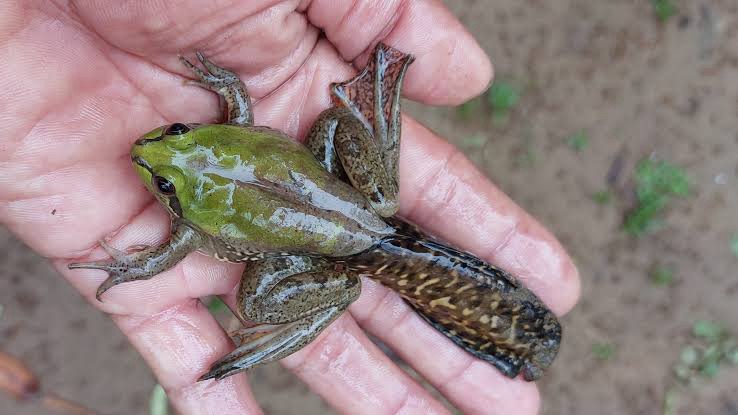
Upon reaching adulthood, the Flower Frog demonstrates a series of adaptations that facilitate its life outside the water. The first of these adaptations is the significant reduction in body size. This shrinkage is not merely aesthetic; it allows for better camouflage among terrestrial vegetation, thus avoiding predators. Additionally, the hind limbs become more robust and are better equipped for locomotion on land, highlighting its ability to jump long distances.
Another crucial aspect of its adaptation is the skin covering. While tadpoles have more permeable membranes, adults develop thicker skin, which helps retain moisture and resist the sun’s heat. This change is vital, as many terrestrial habitats can be dry and hostile. Thus, the skin acts as a barrier, allowing the Flower Frog to survive in drier environments.
Survival Behaviors and Strategies
The social behaviors of the Flower Frog also evolve during the adult phase. If previously the tadpole was confined to water, as proposed in other aquatic species, now the adult actively seeks interactions through complex vocal calls. These vocalizations not only attract mates but also communicate dangers to their peers. Therefore, life on land is not just a battle for survival but also a delicate dance of social and environmental interaction.
As the journey of the adult Flower Frog continues, it adapts and evolves immensely, preparing for the new revelations it shares in its environment. The next chapter will take us to explore the intriguing curiosities about this remarkable creature, from its diet to the complex social interactions that define its existence.
Curiosities about the Flower Frog
Glimpsing the Flower Frog, or Pseudis paradoxa, is to discover a world filled with extraordinary curiosities. This amphibian, which draws attention for its giant tadpole, has an intriguing diet and fascinating social behaviors that often go unnoticed. Let’s dive into the enchanting universe of this small inhabitant of tropical waters.
Diet and Feeding Habits
Initially, the Flower Frog has a quite varied diet. As a tadpole, it primarily consumes aquatic vegetation. As it becomes an adult, its diet shifts to include insects, larvae, and even small crustaceans. This adaptation not only showcases its versatility but also highlights the importance of the environment for its survival. However, the Flower Frog is not just a mere predator; it also plays a crucial role in controlling insect populations, thus helping to maintain ecological balance.
Social Behavior and Interactions
In addition to its intriguing diet, the social behavior of the Flower Frog is equally remarkable. Adults often gather in groups, especially during the breeding season. During mating, males emit melodious vocalizations that attract females, a sound spectacle that resonates throughout the pond. Observations indicate that these amphibians may even exhibit parental care behaviors, something rare in many species. This suggests a level of social complexity that deserves recognition.
Thus, the Flower Frog is not just a natural curiosity but an example of how coexistence and adaptation to the environment are essential for life. Delving into its characteristics leads us to better understand its importance in the ecosystem. Therefore, at the end of this dive into its fascinating life, we prepare to explore the importance of conserving this unique species.
The Importance of Conserving the Flower Frog
Imagine for a moment a vibrant ecosystem, where every living being plays a crucial role. Now, consider that the Flower Frog (Pseudis paradoxa), with its intriguing journey from giant tadpole to compact adult, is in danger. This amphibian, so fascinating for its metamorphosis, is also an indicator of environmental health. Its preservation is vital for the balance of its habitat and, consequently, for many other species around it.
The Interconnection of Species
When we talk about the conservation of the Flower Frog, it is essential to understand the interdependence of all creatures on our planet. The habitats where these frogs live are often home to an immense diversity of fauna and flora. Pseudis paradoxa is not only a marvel of evolution but also a crucial component in its food chain. The small insects that make up its diet help control pest populations, creating a cascading effect that benefits the entire ecosystem.
The Role of Humans in Conservation
Beyond ecological value, the endangerment of this species can signal larger problems, such as the degradation of the natural environment. The good news is that simple actions can generate significant impacts. For example, restoring wetlands not only benefits the Flower Frog but also many other species that depend on these environments. Thus, by caring for the Flower Frog, we protect the biodiversity that surrounds us, reinforcing the importance of small actions that, together, can make a significant difference. Conserving Pseudis paradoxa and its habitat is an essential step in preserving the delicate ties that sustain all life. In this sense, awareness of biodiversity shows us that small changes in attitude have the potential to create a profound impact.
Conclusions…
The metamorphosis of the Flower Frog (Pseudis paradoxa) is an impressive example of how nature adapts through the phases of life. From its early days as a tadpole to the surprising shrinkage upon becoming an adult, this species teaches us about the complexities of evolution. As a result, understanding these transformations not only enriches our knowledge of biodiversity but also highlights the importance of protecting the habitats where these animals live. Protecting the Flower Frog, as well as other species that play fundamental roles in the ecosystem, is essential to ensure the health of our planet.
Did You Know?
- What is the difference between the tadpole and the adult? The Flower Frog tadpole is giant and aquatic, while the adult is smaller and terrestrial, exhibiting different behavior.
- Why does the Flower Frog shrink when it becomes an adult? This shrinkage is an evolutionary adaptation that allows for a more efficient and resource-economical life.
- What is the natural habitat of the Flower Frog? The Flower Frog is primarily found in freshwater areas, such as ponds and rivers, in South America.
- Is the Flower Frog an endangered species? Although it is not in immediate danger, habitat destruction and pollution pose risks to its population.
- How many stages are there in the metamorphosis of the Flower Frog? The metamorphosis of the Flower Frog goes through several stages: egg, tadpole, and adult, each with distinct characteristics.
- Does the Flower Frog have natural predators? Yes, both adults and tadpoles can be preyed upon by fish and birds that inhabit the same aquatic environments.
- What are the main threats to the Flower Frog? The main threats include habitat loss due to deforestation, pollution, and climate change.
- How can I help protect the Flower Frog? You can help by promoting the conservation of aquatic ecosystems and educating others about the importance of biodiversity.