Jewel Wasps: The Parasite That Turns Cockroaches into Zombies
The jewel wasp, scientifically known as Ampulex compressa, exerts a fascinating control over cockroaches, transforming them into submissive creatures. This phenomenon not only reveals the complexity of nature but also highlights parasitic interactions that challenge our understanding of life.
The Fascination of Parasitic Wasps
Imagine a world where an insect becomes a true maestro of manipulation, orchestrating its own life cycle in a way that borders on the supernatural. Parasitic wasps, particularly the jewel wasp (Ampulex compressa), are masterfully complex examples of adaptation and survival. These fascinating creatures not only play a crucial role in the ecosystem but also offer an intriguing window into the secrets of evolution.
Parasitic Wasps: Archetypes of Complexity
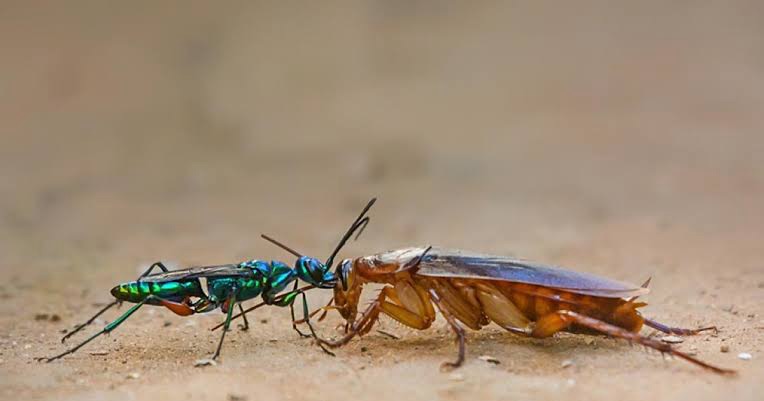
Like an artist painting a masterpiece with precision, parasitic wasps are carefully selected for their task. They differ from other insects not only by their distinct morphology but also by their reproductive strategies. The jewel wasp, in particular, employs an impressive technique: injecting venom into cockroaches, turning them into controlled ‘zombies.’ This behavior is not only a testament to its skill but also a delicate balance in the ecosystem, regulating cockroach populations and contributing to biodiversity.
Impact on the Ecosystem
The importance of parasitic wasps goes beyond what can be observed at first glance. They act as a natural control force, balancing insect communities. With variation in their prey, they ensure that no species becomes overly dominant. This dynamic is fundamental to maintaining the health of ecosystems. Moreover, by studying these insects, scientists can find valuable clues about disease resistance and ecological interactions. For those fascinated by the intricate details of life on our planet, the relationship between the jewel wasp and its prey is truly remarkable.
As we contemplate the beauty and complexity of parasitic wasps, we are led to consider the life cycle of the jewel wasp, which will reveal even more secrets about this intriguing predator-prey relationship.
The Life Cycle of the Jewel Wasp
Like many of nature’s great mysteries, the life cycle of the jewel wasp, Ampulex compressa, unfolds in an intricate and subtle dance. This parasite, which has enchanted and intrigued biologists, has a fascinating and complex method of perpetuation. The journey begins when the female jewel wasp chooses a cockroach as her living incubator. With surgical precision, she then injects her eggs into the victim, marking the start of an extraordinary transformation.
Oviposition and Cockroach Behavior
Shortly after oviposition, the eggs remain hidden and safe inside the cockroach’s body. What is even more fascinating is how the wasp ensures that the cockroach remains alive. At a crucial moment, the wasp injects a venom that affects the cockroach’s control centers, making it temporarily obedient. Thus, the cockroach not only survives but also becomes a kind of zombie, instinctively following the wasp’s commands while the eggs develop.
When the larvae hatch, they do not immediately attack the cockroach but instead slowly explore the host’s body. This behavior, in turn, ensures that the cockroach still has the energy necessary to move, guaranteeing a constant supply of nutrients. This symbiotic relationship of life and death continues until the larvae are fully developed. Finally, when the larvae are ready, they consume the cockroach’s body from the inside out, completing their life cycle while leaving behind the ghost of what was once an active insect. The fascinating life cycle of the jewel wasp is a testament to the power of nature and its ingenious survival tactics, prompting us to question how far life will go to perpetuate its own existence.
As we delve deeper into the venom that transforms the cockroach into a zombie, a new level of complexity emerges, revealing surprising details that intertwine with this life cycle.
The Venom and the Transformation of Cockroaches
Imagine a small insect, a wasp that, with cunning and precision, becomes a mind controller. The jewel wasp (Ampulex compressa) possesses a venom that transforms cockroaches into authentic puppets of its will. It is a fascinating and terrifying spectacle at the same time, highlighting the complexity of interactions in the animal and plant kingdoms.
The Power of Venom
The wasp’s venom is an extraordinary mixture of neurotoxins that act directly on the cockroach’s nervous system. Studies show that, once stigmatized, the cockroach becomes more vulnerable. Its locomotion and behaviors are altered, leading it to a state of submission. The wasp can then lead the weakened cockroach to a safe location, where it can deposit its eggs, thus ensuring the perpetuation of its species.
Furthermore, research indicates that the wasp utilizes sophisticated biochemical mechanisms that inhibit certain neural pathways while enhancing others. This phenomenon is so captivating that scientists have begun to investigate the medicinal potential of the venom’s compounds. By understanding these transformations, we begin to glimpse a new horizon in the field of neuroscience.
Revealing Studies
According to neuroscience experts, the wasp’s venom not only paralyzes the cockroach but also permanently modifies its way of interacting with the environment. Therefore, this predator-prey relationship gains a new dimension, where the wasp assumes the role of manipulator, demonstrating that in nature, every action is imbued with intention. The cockroaches, once agile and autonomous, transform into subservient zombies, a moment that leads us to question the fragility of life and the influence of instinct.
Before we continue our exploration, it is vital to understand how this intricate relationship between the wasp and the cockroach influences the broader ecological context. The implications are vast and directly impact biodiversity and the survival of other species.
Interactions in the Ecosystem
The fascinating dance of death and life unfolds under the watchful eye of nature. In this ecosystem, the jewel wasp (Ampulex compressa) emerges as an extraordinary predator, while cockroaches play the tragic role of hosts under the dominion of this ingenious parasite. This relationship is not merely one of predator and prey; it is a complex symbiosis that impacts not only those involved but also the entire web of life around.
The Jewel Wasp and Its Cockroach Hosts
By injecting its venom into a cockroach, the jewel wasp alters its behavior, transforming it into a zombie that obeys strangely subtle commands. This manipulation not only ensures the survival of the wasp’s larvae, which will feed on the living cockroach, but also secures the continuity of a dynamic that affects the cockroach population in its habitat. What may seem like a cycle of death is, in fact, a form of ecological control. By managing cockroach populations, the jewel wasp, therefore, promotes a balance that benefits other species in the ecosystem.
Impacts on Biodiversity
In this context, it is worth noting that the presence of the jewel wasp can increase local biodiversity. By keeping the cockroach population at healthy levels, this wasp provides space and resources for other organisms. In environments where the jewel wasp is abundant, competition between species decreases, creating a more favorable climate for coexistence.
Thus, the jewel wasp undoubtedly illustrates how a predatory act can have profound ecological repercussions. As we explore the truths of wildlife, this interaction between the wasp and cockroaches teaches us about the delicate balance present in a world that is both beautiful and brutal. As we prepare for reflections on the nature of parasitism, we must consider the significance of these complex interactions.
Reflections on Nature and Parasitism
At first glance, the macabre dance between the jewel wasp (Ampulex compressa) and its prey, the cockroach, seems devoid of any charm. However, upon closer inspection, a fascinating narrative emerges that illustrates the complex interactions of nature. This relationship is not just an example of parasitism; it is a lesson about the brutality and beauty of wildlife.
The Role of Parasitism in Ecological Balance
As all living beings are interconnected, parasitism plays a fundamental role in preserving ecological balance. The jewel wasp, by injecting its venom into the cockroach, not only ensures its survival but also influences the dynamics of the cockroach population. Without predators like this wasp, some species could dominate and destabilize entire ecosystems. Thus, parasitism, often viewed with disdain, is an essential mechanism for population regulation.
Philosophical and Ecological Reflections
The relationship between the jewel wasp and its victim evokes profound philosophical questions about the nature of life and death. By understanding this cycle of life and death, we are led to reflect on our own condition. How can we, as a species, justify the predatory relationship we establish with our environment? The jewel wasp teaches us that even in the cruelty of parasitism, there is a natural and necessary order. It is part of a process that, on a large scale, aims at the continuity of life on the planet. Therefore, as we step away from this intriguing chapter, we carry with us a salute to the natural cycle of life, reminding us of the complex webs that connect all creatures. Moving forward, we encounter the intriguing Scorpion Fly, whose physical form is a spectacle in itself.
Conclusions…
The interaction between the jewel wasp and cockroaches illustrates the complexity of parasitic relationships in the animal kingdom. The transformation that cockroaches undergo is not just an intriguing phenomenon; it highlights the adaptability and survival mechanisms of both species. Thus, while the jewel wasp controls its prey, it also teaches us about the incredible biodiversity and interactions that govern life on our planet. By understanding these dynamics, we broaden our perspective on the ecosystem and the crucial role each organism plays. In the end, the cycle of life is filled with surprises, and the jewel wasp is one of many examples that lead us to reflect on nature more deeply.
Did You Know?
- How does the jewel wasp infect cockroaches? The jewel wasp injects venom into the cockroach, transforming it into an obedient ‘zombie,’ facilitating oviposition.
- What is the life cycle of the jewel wasp? The life cycle involves the jewel wasp laying eggs inside the cockroach, which is still alive. The eggs develop and eventually kill the cockroach.
- Is it common to see jewel wasps in urban environments? Yes, the jewel wasp can be found in urban areas, as cockroaches are prevalent in these environments.
- Do cockroaches die immediately after being infected? No, cockroaches remain alive for a while after infection while the eggs develop.
- Does the venom of the jewel wasp affect other insects? The venom is specialized for cockroaches and does not have a significant effect on other insects.
- What are the ecological impacts of the jewel wasp? It helps control the cockroach population, affecting the food chain and ecosystem dynamics.
- Is the jewel wasp dangerous to humans? No, the jewel wasp is not dangerous to humans, as its venom acts specifically on cockroaches.
- How can I recognize a jewel wasp? The jewel wasp is recognizable by its vibrant colors and long antennae.