The Fascinating Green Sea Turtle
The green sea turtle, a majestic species of marine turtle, enchants oceans and tropical islands. In this deep dive, we will explore its biology, habitat, behavior, and the crucial role it plays in marine ecosystems.
The Biology of the Green Sea Turtle
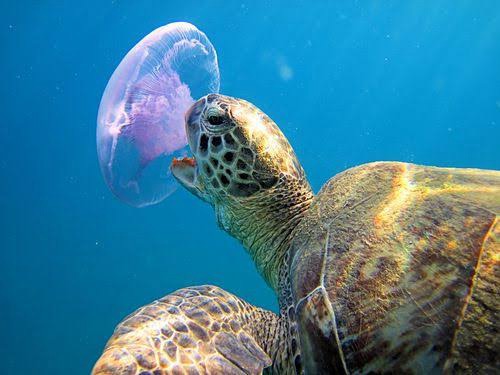
The green sea turtle, majestic in its oceanic journeys, has an aerodynamic body adapted for long underwater travels. With a rounded shell that can reach up to 1.5 meters in length, these turtles are a true marvel of natural engineering. Their shell is made up of shields composed of keratin, a resilient substance that provides protection against predators and structural strength during their crossings.
Their long and powerful flippers evoke the movement of oars, propelling them in a graceful and efficient swim. These underwater ‘wings’ are essential not only for locomotion but also for their survival in a rugged and unpredictable habitat. The green sea turtle is one of the rare species that can live in both shallow waters and the depths, adapting swiftly to environmental changes.
Internally, the digestive system of green sea turtles is particularly adjusted to their predominantly herbivorous diet. They primarily feed on algae and seagrasses, which gives them a greenish coloration, both in their internal tissues and in their fat. This diet is crucial for maintaining the balance of aquatic ecosystems, as the green sea turtle helps control the excessive growth of marine vegetation.
Another remarkable aspect is their notable navigation system, still not fully unraveled by scientists. These turtles exhibit a surprising sense of direction, capable of guiding them back to the beaches where they were born to nest, after years wandering the oceans. This mystery of nature continues to inspire and intrigue marine biologists.
As we explore more about the green sea turtle, we can appreciate the complex and symbiotic relationship it maintains with the marine environment it inhabits.
Habitat and Distribution
The green sea turtle, a majestic inhabitant of tropical and subtropical seas, finds refuge in vast marine environments around the globe. These turtles choose shallow coastal waters and protected lagoons to live, where submerged vegetation proliferates. The preference for areas rich in seagrasses and algae is not by chance; it is a vital choice, as these underwater fields provide not only shelter but also their main source of food.
Along the coasts of Central America, through the Caribbean Islands, to the shores of West Africa, we find the green sea turtle undertaking long migratory journeys. After nesting, they return to the same location where they were born, a behavior rooted in their incredible sense of direction. These epic journeys, crossing oceans, ensure that new generations have a safe habitat to breed and develop.
However, the green sea turtle faces significant challenges. The degradation of coral reefs and water pollution threaten their foraging areas. Proximity to human development, with its beaches invaded by constructions and blinding lights, interferes with their nesting sites. Preserving these areas is vital to ensure the survival of this iconic species.
The delicate balance of the green sea turtle’s habitat is a reminder of the complexity of oceanic ecosystems and how each element is interdependent. Just like orcas, which fascinatingly dominate their aquatic environments, these turtles play a crucial role in our oceans. For more about marine creatures, see if the orca is a whale or a dolphin.
Behavior and Feeding
The green sea turtle stands out among its marine companions due to its distinctly herbivorous diet. During their early years in the open ocean, their diet is more diverse, but as they mature, these extraordinary creatures become predominantly vegetarian. Adult turtles find food in shallow waters, where they graze on dense meadows of algae and seagrasses. This diet is a crucial factor for their survival, providing essential nutrients and directly impacting the health of the ecosystem they inhabit.
Known as ‘gardeners of the sea’, the way they eat helps maintain the balance of seagrass meadows. By controlling the growth of seagrasses, they prevent them from becoming thick and suffocating, allowing countless other marine species to thrive. Such behavior underscores a vital ecological role comparable to that of other herbivores in different biomes, like the rhinoceros in African savannas. Observations reveal that when they rest, they position themselves near food sources, minimizing the need for long movements and conserving energy.
The choice to consume plants may seem surprising for a marine animal, but this adaptation protects the green sea turtle from predators that frequent more open and deeper areas. This behavioral adaptation is, therefore, not just a matter of nutrition but also of safety. Just like the fascinating camouflage and protection adaptations observed in other creatures, such as the jumping spider, green sea turtles exhibit impressive evolutionary strategies. This feeding behavior further reinforces the sensitive bond between the green sea turtle and the marine environment, a relationship of mutual conservation and essential ecological dependence.
Reproduction and Life Cycle
In the vast ocean, green sea turtles undertake one of the most extraordinary migratory journeys. They can travel thousands of kilometers between feeding areas and nesting beaches. This intrinsic migratory instinct guides females back to the place of their birth to lay their own eggs. This wonderful phenomenon, known as philopatry, positions green sea turtles as true navigators of the sea.
During the mating season, usually coinciding with the warmer months, the female chooses a mate and, after mating, begins her journey to the nesting beaches. Upon arrival, she waits for the cover of night and laboriously drags herself across the sand until she finds a suitable spot. There, she digs a nest where she will lay about 100 eggs. Then, she carefully covers the nest with sand, camouflaging it from predators and the intense heat of the sun.
For approximately two months, the eggs incubate silently beneath the sand. The tiny turtles emerge as a miracle of nature, differing from many other reptiles, as the temperature of the nest during incubation determines the sex of the hatchlings. After emerging, they face the dangerous journey to the ocean, a desperate race for survival against lurking voracious predators.
Those who manage to reach the waters have a chance to grow and one day return to the same beach to restart the cycle. This incredible phenomenon is just one of many examples of how nature knows how to preserve life. For more information on animal adaptations in nature, see how the Ladybug demonstrates fascinating strategies.
Conservation and Threats
The green sea turtle, a magnificent marine reptile, faces insidious threats. The beaches where they nest are now contested by hotels and tourists, pressuring these fragile nests. Artificial light on beaches confuses newly hatched hatchlings, who must head to the sea but are drawn to the land.
Plastic pollution in the oceans poses another threat. The green sea turtle sees packaging and abandoned nets as food, leading to serious health issues. Additionally, accidental fishing in commercial nets is a significant cause of death.
Global climate change adds complex challenges. Rising sea temperatures can harm coral ecosystems, crucial habitats for turtles. Rising sea levels and more frequent weather events threaten to destroy nesting beaches.
Conservation initiatives are being carried out globally. Educational programs inform local communities about the importance of preservation. Some beaches have created lighting controls to assist hatchlings, and strict laws are enforced to prevent egg collection.
Beach patrols by volunteers are a testament to human dedication to the cause. These initiatives are essential for increasing survival rates.
Another innovative approach is the use of technology, such as drones, to monitor fluctuations in marine populations. This technique minimizes direct human impact and provides accurate data for conservation strategies.
These efforts offer hope, but it is vital that awareness increases. With collaborative actions, we can ensure that the green sea turtle navigates the oceans for many generations. If interesting discoveries in conservation are of interest to you, consider exploring how a newly discovered fungus in the Amazon may impact biodiversity.
Conclusions…
The green sea turtle is an incredible species that plays a vital role in marine ecosystems. Its preservation is essential to ensure the health of the oceans and biodiversity. We must unite to protect these majestic beings and their habitats.
Did You Know?
What group does the sea turtle belong to?
Sea turtles belong to the group of chelonians, which include turtles, tortoises, and terrapins.
What are the 7 types of sea turtles?
The seven types of sea turtles include the green turtle, leatherback turtle, hawksbill turtle, loggerhead turtle, common turtle, flatback turtle, and the olive ridley turtle.
What is the classification of the turtle?
The green sea turtle is classified in the order Testudines and the family Cheloniidae.
What group does the turtle belong to?
The turtle belongs to the group of chelonians, characterized by their shells and aquatic abilities.
How to identify sea turtles?
Sea turtles can be identified by their shell, body shape, swimming behavior, and coloration that varies among species.
How long can a sea turtle stay out of the water?
Sea turtles can stay out of the water for several hours, but the duration varies depending on the species and environmental conditions.
What is the family of the turtle?
The green sea turtle belongs to the family Cheloniidae.