Goblin Shark
In the depths of the oceans, an intriguing creature, the goblin shark, challenges our perception of what a shark is. This prehistoric species, with its unique characteristics and enigmatic behavior, captivates both scientists and marine life enthusiasts. Let’s explore the fascinating world of this unusual species.
What is the Goblin Shark?
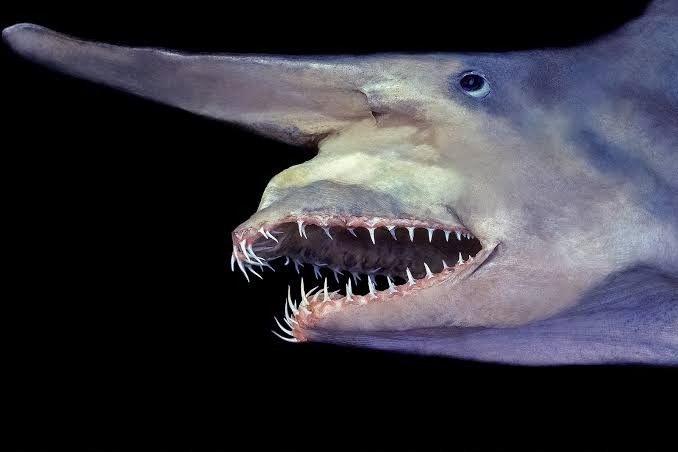
Amidst the abysses of the deep ocean emerges one of the most enigmatic spectacles of the underwater world: the goblin shark. This predator, with its ancestral appearance, captures the imagination with its unique and intriguing shape. Its most distinctive feature is its long, flattened snout, which protrudes like a sword near its head. Beneath this snout lies its unprecedented extensible jaw, capable of projecting rapidly to capture unsuspecting prey. With a slender body covered by translucent pink skin, the shark displays blood vessels that further accentuate its spectral appearance.
Scientifically, the goblin shark belongs to the Mitsukurinidae family and stands out among the Chondrichthyes, a group of cartilaginous fish that includes other sharks and rays. The scientific name, Mitsukurina owstoni, honors its discoverer and reflects its ancient lineage. Goblin sharks are considered living fossils, with evolutionary links dating back over 125 million years. This makes them not only an exceptional fish but also a vital subject of study in understanding the evolution of marine vertebrates.
Among the curiosities surrounding the goblin shark, the ingenuity of its hunting stands out. Rarely seen, it glides silently in the deep ocean corners. Its jaws are a fascinating adaptation, allowing it to capture agile prey that passes nearby. The depth at which it resides poses challenges for research. Observing it requires advanced technologies, just as seen in other extreme-depth species, such as the tardigrade, known for its resilience and adaptability in extreme conditions. As ocean explorers continue to unravel its mysteries, the goblin shark remains an unusual ambassador of the unexplored deep seas.
Habitat and Distribution
The enigmatic goblin shark inhabits the dark depths of the ocean, a realm still little explored by humans. Widely occurring in pelagic environments of deep waters, this fascinating being is rarely sighted above 200 meters deep. In fact, it is more commonly found between 400 and 1,200 meters. These zones are known as the Bathypelagic, a region where darkness reigns and pressure is overwhelming.
The vast habitat of the goblin shark extends across the Atlantic, Indian, and Pacific Oceans, primarily around continental margins and seamounts. In these impenetrable depths, the water temperature is surprisingly low, often close to zero degrees Celsius. There, the scarcity of sunlight prevents photosynthesis, creating an environment that values energy efficiency.
The isolation of the depths imposes a Herculean challenge for scientists studying this elusive being. Extreme pressure limits the operational time of submersibles and equipment in discoveries. However, exploring these zones is crucial for better understanding the evolution and adaptation of creatures like the goblin shark. The unique morphology of the goblin shark, with its peculiar snout and extensible jaws, is closely linked to these isolated and high-pressure areas. Researchers hope to unravel the mysteries of its physiology that allow it to thrive in these abysses. To succumb to the fascination of this creature, we can compare it to the enigmatic tardigrade, which also adapts to extreme environments. Exploring the goblin shark’s home opens a portal to the wonders still hidden in the ocean’s shadows.
Behavior and Diet
The goblin shark, a creature of almost mythical appearance, glides silently through the depths of the ocean. With a remarkable ability to disappear into the darkness, it is a predator adapted to the planet’s most challenging environment. To survive thousands of meters deep, the goblin shark has developed fascinating behaviors. Observations suggest that it moves slowly, conserving energy in the vast ocean expanses where food is scarce.
Its diet reflects its ability to adjust to hunting opportunities. The goblin shark primarily feeds on crustaceans, cephalopods, and deep-sea fish, adapting to what its inhospitable home offers. To capture its prey, it employs a unique method: upon detecting a potential meal, the goblin shark projects its jaw forward with surprising speed, a mechanism that functions like a ‘slingshot’ to catch unsuspecting prey. This movement is facilitated by a complex system of tendons and cartilages that acts as a living trap.
Along with its hunting skills, the goblin shark possesses advanced sensory organs. The ampullae of Lorenzini allow it to perceive the faintest electrical signals emitted by prey, even in the darkest waters. Such a device makes it an excellent hunter, even in places where light is almost nonexistent. Despite its efficiency, the existence of the goblin shark is threatened by modern dangers, such as fishing and habitat degradation, challenges that will be explored later. In other latitudes of the animal kingdom, adaptable hunting tactics, like those of the squid, also illustrate the surprising diversity of survival strategies in nature.
Threats and Conservation
In the dark depths of the oceans, the enigmatic goblin shark faces dangers that threaten its existence. This ancestral species is rarely sighted, but even in its depths, the impacts of human activity are undeniable. Bycatch in deep waters poses a significant threat. Nets and longlines, designed to capture other species, often inadvertently snag these sharks, resulting in their injury or death.
In addition to bycatch, marine habitat degradation poses risks. Drilling for oil and gas, along with seabed mining, disturbs their habitats. Sediments stirred up by these activities can impair the water quality where the shark lives. This, in turn, affects its ability to navigate and find food.
Conservation of this unique species requires coordinated global effort. Stricter regulations on deep-sea fisheries can reduce bycatch. Education and awareness campaigns can help pressure governments and industries to implement more sustainable practices. Establishing marine protected areas, where human exploration is limited, also safeguards the goblin shark’s habitats.
Innovative and technological solutions are equally promising, such as the development of less invasive fishing gear. Scientific research is crucial; more explorers must document the mysteries of the deep ocean to better understand the behavior of this indescribable species. The goblin shark shares its domain with countless forms of life still unknown; every means to protect it also serves to save the habitats of other equally precious species.
Ecological Importance
In the deep and dark zones of the ocean, the goblin shark plays a fundamental role in maintaining ecological balance. This deep-sea inhabitant is an efficient predator, aiding in the population control of various marine species. By regulating the number of other organisms, such as cephalopods and smaller fish, it ensures that no species assumes a dominant position, thus disrupting the ecosystem.
The presence of the goblin shark, although discreet, is an indicator of the health of deep-sea marine habitats. Its diverse diet and the positions it occupies in the food chain make it a crucial component in trophic chains. A decline in its populations can lead to a cascading effect, impacting the abundance and diversity of species.
Moreover, goblin sharks are part of a broader group, the elasmobranchs, whose role in the nutrient cycle is vital. Moving through different ocean regions, they help redistribute nutrients, sustaining the productivity of other marine and coastal ecosystems.
Preserving the goblin shark is therefore essential for the global health of the oceans. This conservation also has intrinsic value, maintaining biological diversity and ensuring the proper functioning of marine ecosystems. Without predators like the goblin shark, the oceans may see uncontrolled increases in some species, leading to the depletion of essential resources.
For more information on marine preservation, read about the fascinating contribution of one of the most intelligent creatures in the oceans, the jumping spider, highlighting the complexity and interconnectedness of ocean life. Understanding and protecting the goblin shark is, therefore, an investment in the resilience and future of our seas.
Conclusions…
The goblin shark, with its unique appearance and fascinating behavior, represents the complexity of marine life. Despite its frightening appearance, it is an essential part of its ecosystem. This prehistoric fish reminds us of the importance of protecting the mysteries that still inhabit our oceans.
Did you know?
What is the goblin shark?
The goblin shark is a species of shark with a peculiar appearance, known for its prehistoric characteristics and unique shape.
Where does the goblin shark live?
This species primarily inhabits the depths of the ocean, where conditions are extreme and little known.
What is the diet of the goblin shark?
The goblin shark feeds on squids, fish, and other organisms it encounters in its deep environment.
Is the goblin shark threatened with extinction?
Yes, due to overfishing and habitat degradation, the goblin shark faces extinction risks and requires protection.
Why is the goblin shark important to the ecosystem?
This shark plays a crucial role in the marine food chain, helping to maintain the balance of oceanic ecosystems.