
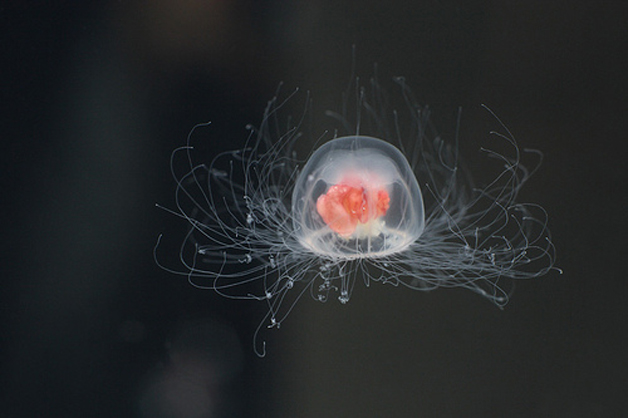
Immortal Jellyfish: The Jellyfish of Eternity
The immortal jellyfish, or Turritopsis dohrnii, is a fascinating creature that defies the natural cycle of life. This intriguing marine organism possesses the unique ability to reverse its aging, offering new perspectives on biology and immortality.
The Fascinating Turritopsis dohrnii
Turritopsis dohrnii, better known as the immortal jellyfish, presents an intriguing story of survival and adaptation. Native to the warm waters of the Mediterranean Sea, its presence has spread worldwide, becoming a curiosity in tropical and subtropical oceans. This jellyfish is small, with a diameter of only 4 to 5 millimeters, but it possesses extraordinary power in its biology.
This creature has the unique ability to reverse its life cycle. When threatened or injured, Turritopsis dohrnii initiates a remarkable rejuvenation process. Instead of dying, it reverts to its juvenile state, a phenomenon that distinguishes it as a true miracle of nature.
Its gelatinous structure is composed of specialized cells that allow this transformation. It is characterized by a bell-shaped body, with long tentacles that serve both for capturing prey and for defense. The coloration varies from light shades to greens, depending on environmental conditions.
Jellyfish are often found in marine environments with low pollution and an abundance of nutrients. They feed on small plankton and organisms, playing a fundamental role in the marine food chain. Their ability to adapt to different environmental conditions makes them a fascinating element of the marine ecosystem.
For those who wish to understand more about intriguing creatures in the animal kingdom, the jumping spider serves as an impressive example of how nature continues to surprise with its complexities.
The Rejuvenation Process
The jellyfish Turritopsis dohrnii, popularly known as the immortal jellyfish, is fascinating not only for its ethereal appearance but also for its extraordinary rejuvenation mechanism. When faced with stress, these creatures possess a unique ability: they can reverse their life cycle. This phenomenon is known as transdifferentiation. This transformation begins when the adult jellyfish, after a stressful event, such as a lack of food, migrates to its juvenile stage.
The cells of the adult jellyfish undergo a complex process. They change shape and function, an essential characteristic of transdifferentiation. In this process, differentiated cells transform into stem cells, a versatile type of cell. Then, these stem cells specialize again into polyp cells, which are the juvenile form of the jellyfish.
The first step in this phenomenon is *apoptosis*, programmed cell death. Cells that are not needed self-destruct, freeing up space and resources for new cells. Once the jellyfish’s body is reorganized, the stem cells begin to proliferate. They transform into cells of different tissues of the polyp, such as muscles, epithelium, and eventually, those of the jellyfish’s tentacles.
This incredible process is not just a survival skill. It challenges many preconceived notions about aging and mortality in biology. The study of the mechanisms that enable this rejuvenation has significant implications. Just like the tardigrade, which also exhibits extreme resilience characteristics, the immortal jellyfish opens new horizons for biological research and potentially for regenerative medicine.
What Does Immortality Mean?
Immortality, a concept that fascinates humanity, takes intriguing forms in the biological realm. For the immortal jellyfish (Turritopsis dohrnii), this idea materializes in an extraordinary way. Unlike organisms that age and die, this jellyfish has developed the ability to reverse its life cycle. When under stress or injury, it transforms its cells, restarting its growth.
In biology, immortality is not just an ethical and philosophical challenge. It represents an adaptive phenomenon. The immortal jellyfish exhibits cellular plasticity, an ability that allows survival in hostile environments. This process is known as transdifferentiation, where cells reprogram themselves to become other cell types.
This capability raises questions about aging, a mystery revered in modern science. The study of the immortal jellyfish may provide valuable insights into human aging biology. Factors such as oxidative stress and apoptosis, which normally lead to cell death, can be studied in light of this resilient organism. It may teach us about the reversibility of cellular changes and the potential for regeneration.
Although immortality may seem a distant mirage for humans, understanding how the immortal jellyfish stores and manipulates its genetic code could bring significant advances in modern medicine. The quest for longevity, or even for reversing aging, finds inspiration in this small invertebrate.
For a view on how special creatures adapt and evolve, learn more about elephants, which also show resilience and complexity in their social behaviors.
Implications for Longevity Science
The fascinating immortal jellyfish, or Turritopsis dohrnii, has proven to be a remarkable testament to resistance against the passage of time. By exploring its unique biological processes, scientists encounter valuable clues about how marine eternity may offer answers to the human challenge of aging. This small creature has the ability to reverse its life cycle, returning to a juvenile state after reaching maturity. Such a phenomenon raises intriguing questions about the possibility of extending the lifespan of humans.
The study of the immortal jellyfish may inspire new approaches in biomedicine, focused on cellular regeneration and tissue repair. If we can understand the mechanisms that allowed the immortal jellyfish to evade death, we may replicate these processes in human cells. The implications of such discoveries have the potential to revolutionize anti-aging treatments. By uncovering what makes this jellyfish unique, science may find new foundations for effective therapies.
Laboratory experiments address the modulation of genes related to aging, using the knowledge gained from the immortal jellyfish as a foundational material. Researchers explore innovative policies, seeking to increase the resilience of human cells similar to the resilience found in the cold waters of the oceans where the jellyfish lives.
The search for anti-aging treatments has gained a new horizon, and the immortal jellyfish may be the key to this vital transformation. The medicine of the future may expand to include marine biology as a rich source of knowledge, thus changing our understanding of the cycle of life and death.
The Jellyfish and the Future of Biology
The immortal jellyfish, Turritopsis dohrnii, offers a fascinating perspective on the resilience and adaptation of marine creatures. This species, capable of reversing its life cycle, exemplifies how biology can reinvent itself in the face of challenges. In times of climate change and pollution, understanding these natural processes becomes crucial. The jellyfish’s ability to rejuvenate may inspire studies on cellular regeneration and biotechnology.
The waters of the planet are becoming an ecosystem in constant transformation. Rising temperatures and acidification are forcing many species to adapt or perish. The immortal jellyfish is a symbol of hope. Its uniqueness may provide insights into survival under extreme conditions. Another lesson lies in genetic diversity. Species that exhibit greater variation in their traits have a better chance of resisting environmental stressors. The immortal jellyfish’s ability to adjust its reproductive cycle in the face of adversity proposes a parallel with the preservation of complex habitats. Studies on organisms that exhibit remarkable adaptations, such as the tardigrade, reveal survival strategies in extreme conditions. Learning from these adaptations is essential for the future of marine biology. If Turritopsis dohrnii teaches us anything, it is that innovation and flexibility are crucial in the fight for survival in a rapidly changing world. Therefore, every specimen found in the ocean may be a key to deciphering the enigmas of this new era of biology.
Conclusions…
The immortal jellyfish is not just a spectacle of nature, but also an invitation to reflect on immortality and the mysteries of life. Studying this creature may reveal secrets that not only intrigue biology but also offer hope for the science of longevity.
Did you know?
How long does the immortal jellyfish live?
The immortal jellyfish can theoretically live indefinitely due to its ability to reverse aging.
Why is the jellyfish immortal?
It is considered immortal because it can undergo a process of transdifferentiation, reversing its life cycle.
What animal is immortal?
Besides the immortal jellyfish, there are other creatures like some species of sharks and corals that possess extraordinary longevity characteristics.
Which creature is immortal?
Turritopsis dohrnii, also known as the immortal jellyfish, is the main example of an organism considered immortal.
Which jellyfish is immortal?
The jellyfish Turritopsis dohrnii is famous for its ability to reverse aging and is therefore referred to as the immortal jellyfish.
What causes jellyfish death?
The main causes of jellyfish death include predators, diseases, or unfavorable environmental conditions.
What are immortal animals?
Animals like Turritopsis dohrnii, some species of scallops, and certain mollusks may exhibit characteristics of immortality.
Which jellyfish does not sting?
The rubbery jellyfish is known for not having stinging cells and therefore does not sting.
What creature can live forever?
The immortal jellyfish, Turritopsis dohrnii, is the most well-known creature for its ability to reverse the aging process and potentially live forever.