Urutau, the Ghost Bird
The Urutau, also known as the ghost bird, captivates nature lovers with its impressive camouflage and secretive habits. This article explores in detail its characteristics, habitat, hunting behavior, and conservation challenges, revealing the beauty and uniqueness of this species.
Physical Characteristics
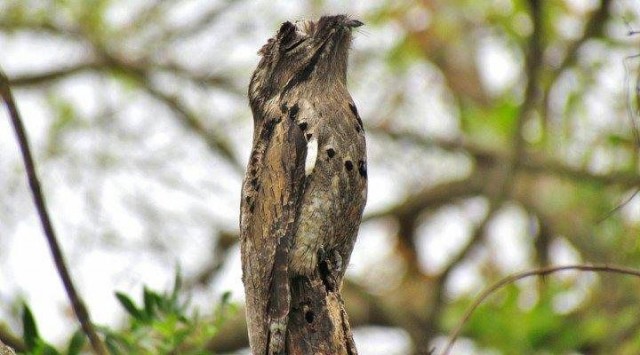
The Urutau, known as the ghost bird, is a fascinating and intriguing bird. Its plumage, in a palette of grays and browns, resembles the bark of a tree. This resemblance is essential for its survival. Perched on branches or trunks, the Urutau becomes almost invisible. It has a robust build and a body that can measure up to 50 centimeters in length. Its wings are wide and long, allowing it to make nearly silent flights, a true master of the discreet art of hunting. The large, expressive eyes are a deep yellow, providing a striking contrast to the rest of its body. This eye characteristic, besides being fascinating, is functional. It provides sharp vision at twilight, the time when the Urutau becomes most active. The beak is short and adapted for catching insects. Its head is relatively large and has feathers that extend like a small crown, adding a majestic touch. The features that contribute to the Urutau’s camouflage are not limited to the color of its plumage. It also adopts postures that mimic branches and trunks. When threatened, it can remain motionless for long periods. This strategy, combined with its coloration, makes it a true ghost of the forests. To discover more about the fascinating world of birds, explore the Toucan, which, like the Urutau, reveals the incredible diversity of birds in their adaptations to the environment.
Habitat and Distribution
The Urutau, known as the ghost bird, inhabits various forest environments but is especially found in regions of dense and subtropical forests. Its preferred habitat includes riparian forests, gallery forests, and areas of Atlantic Forest, which provide both shelter and food sources. These forests, rich in biodiversity, offer an ideal setting for the Urutau to camouflage among trunks and leaves, thanks to its bark-like plumage. This bird is most frequently found in regions such as Brazil, Paraguay, and parts of Argentina. In Brazil, its distribution is wide, occurring mainly in the Southeast region and parts of the North and Northeast, where the humid climate favors the maintenance of its nesting areas. The Urutau exhibits remarkable adaptability, being spotted at different altitudes and in more degraded habitats, although it always prefers dense vegetative areas. Geographic features, such as rivers and mountains, also influence its presence, as Urutaus are known to prefer locations near water. This is due to the abundance of insects and small vertebrates that these environments tend to harbor. Thus, the Urutau’s feeding habits are closely linked to the geography of its habitat. The connection between the Urutau and its environments is evident in its ability to hide and hunt, making it a barometer of the state of tropical forests. For more information about birds that inhabit these regions, you can check out the article on the Biguatinga.
Nocturnal Behavior
The Urutau, known as the ghost bird, reveals its essence at night. With a keen gaze, this nocturnal bird uses the darkness as an ally. Its mimetic plumage, almost imperceptible among the vegetation, provides exceptional camouflage. During twilight, it can be found perched on a low branch, observing all the movement around it.
The hunting capabilities of the Urutau are impressive. It primarily feeds on insects, especially those that become active after sunset. When a target approaches, the Urutau does not hesitate. It launches from the branch with silent grace, capturing its prey with a precise strike.
The sharp senses of this bird allow it to locate and identify its prey in the dark. Its hearing is particularly developed, helping the Urutau detect the slightest movement of insects. Its ability to remain motionless is a valuable resource, allowing it to stay hidden from predators while patiently waiting for its meals.
In addition to hunting, the Urutau exhibits fascinating behaviors during the night. It communicates with soft vocalizations, imbued with an air of mystery. These calls resonate through the forest, attracting mates and defending its territory. With a touch of magic, the twilight dancing Urutau goes unnoticed, maintaining the serenity of the night.
As it delves into the twilight of the forest, the Atomic Urutau exemplifies the beauty of adaptation and survival, navigating through its realm of shadows. This makes it a true wonder of nature, perfectly adapted to the cycle of nocturnal life.
Threats and Conservation
The enigmatic beauty of the Urutau, known as the ghost bird, is often overshadowed by serious threats looming over its habitat. Habitat loss is one of the biggest concerns. Rapid agricultural expansion and deforestation have devastated the tropical forests where this peculiar bird resides. Without these habitats, the Urutau faces difficulties in finding shelter and food.
Human activities, such as urbanization and logging, also impact its survival. Pollution and the introduction of invasive species disrupt the natural balance of the ecosystem, resulting in a scarcity of crickets and moths, its primary prey. As forests become fragmented, the Urutau finds itself isolated in small areas, hindering reproduction and genetic exchange between populations.
Fortunately, several conservation initiatives are being implemented. Reforestation projects are underway in some critical areas. Non-governmental organizations work with local communities to raise awareness about the importance of the Urutau and its habitat. Environmental education has proven vital, promoting sustainable practices that benefit both local wildlife and the human population.
Moreover, protected areas are being created in strategic regions. Such reserves provide the Urutau with a safe environment to reproduce and thrive. Support for scientific research is also crucial. Monitoring Urutau populations and understanding their ecological needs contribute to effective conservation strategies. Through collective efforts, it is still possible to ensure that this magnificent bird remains a part of this beautiful ecosystem. For more information on the importance of species conservation, you can check out this article on toucans.
Ecological Importance
The Urutau, with its ghostly appearance, plays a crucial role in its ecosystem. As a nocturnal predator, this bird helps control insect populations. Its diet consists mainly of moths, crickets, and other insects, serving as a natural regulator of these species. By keeping insect populations in check, the Urutau contributes to ecological balance, benefiting other species that depend on this resource and preventing population outbreaks. In addition to controlling insect populations, the Urutau interacts with various other species. It is an important link in the food chain, serving as prey for birds of prey. The relationship between the Urutau and these birds illustrates the complexity of the ecosystem. Each interaction plays a role in maintaining biodiversity. The presence of the Urutau in a habitat is an indicator of the health of that environment. Its disappearance can signal ecological imbalances, often resulting from environmental degradation. This reminds us of the importance of preserving not only the Urutau but the entire biodiversity around it. The loss of biodiversity affects the resilience of ecosystems. When diverse species disappear, the ecosystem’s ability to adapt to changes diminishes. With the Urutau, we lose an efficient predator and a vital piece in maintaining ecological cycles. Therefore, it is essential to protect natural habitats and promote bird conservation. To learn more about the importance of biodiversity, check out this article on the Toucan.
Conclusions…
The Urutau is a true gem of avifauna, with its ability to camouflage and its intriguing nocturnal habits. The preservation of this bird and its habitat is essential to ensure that this fascinating species continues to enchant future generations. Understanding and protecting biodiversity is a responsibility for all of us.
Did you know?
What is the Urutau?
The Urutau, also known as the ghost bird, is a species of nocturnal bird famous for its camouflage ability, becoming almost invisible in its natural habitat.
What is the habitat of the Urutau?
The Urutau inhabits tropical and subtropical forests, preferring areas near streams and with abundant vegetation that facilitates its camouflage.
How does the Urutau feed?
The Urutau is a nocturnal predator that primarily feeds on insects, using its camouflage to approach its prey unnoticed.