Giraffe: Discover the Fascinating World of the Tallest Land Mammal
The giraffe, with its towering stature and unmistakable neck, is a symbol of uniqueness among mammals. Understanding its life and characteristics helps to appreciate the diversity and complexity of nature.
The Giraffe’s Impressive Anatomy: Much More Than a Long Neck
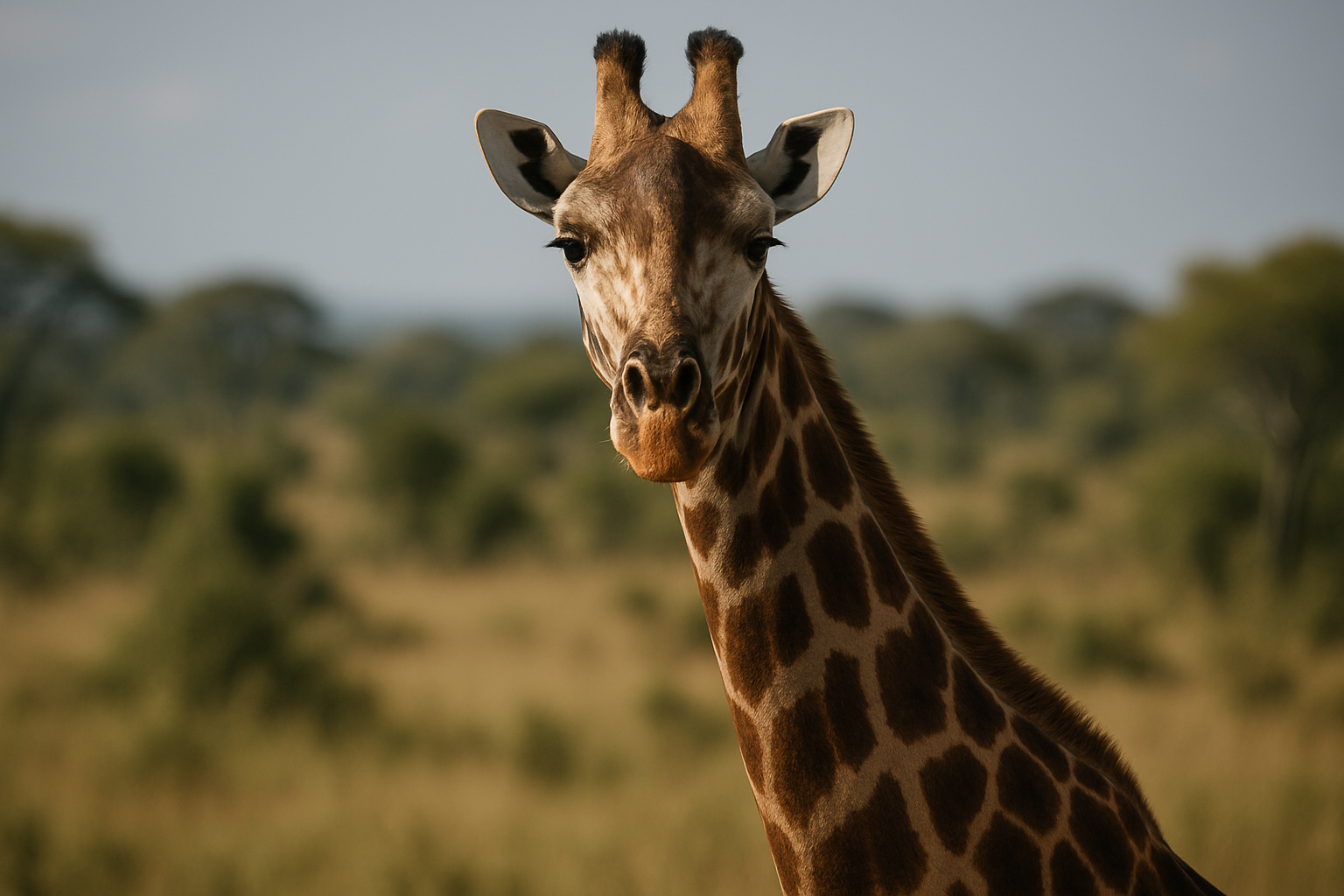
As we move away from the intriguing communication strategies of giraffes, we encounter an even more fascinating structure: their anatomy. This gentle giant, with its long neck and tall legs, reaches a height that can vary from 14.8 to 19.7 feet, making the giraffe the tallest land mammal on the planet. Most of this height comes from its legs and the iconic neck, which comprises almost half of its total height.
The giraffe’s neck, an evolutionary marvel, not only supports the head but is also a crucial tool for reaching the high leaves of trees. Contrary to what one might expect, the giraffe’s neck has only seven vertebrae, the same number found in nearly all mammals, but each vertebra is enormously elongated. The bones are reinforced and interconnected by special muscles and ligaments that help support the weight of the head and neck, offering an impressive fusion of strength and flexibility.
Another remarkable feature is the giraffe’s circulatory system, adapted to handle gravity and the great distance that blood must travel to the brain. The giraffe’s heart, extraordinarily powerful and about twice the size of a common human heart, pumps blood with a much higher pressure than that of other mammals. This mechanism ensures that blood reaches the brain, situated well above the heart.
With such adaptations, the giraffe not only survives but thrives in its environment, using its height to monitor predators and feed on leaves that other herbivores cannot reach. These and many other characteristics make the giraffe a fascinating example of evolutionary adaptation, a true testament to the complexity of wildlife.
By studying these incredible creatures, we naturally move towards understanding not only how they live but also how they impact entire ecosystems. In the upcoming chapters, we will explore how giraffes feed and the influence they exert on the ecosystem, specifically in their complex relationship with acacia trees.
Feeding Habits and Ecology: How the Giraffe Feeds and Influences the Ecosystem
As we approach this chapter, we leave behind the fascinating physical adaptations of giraffes and dive into their interaction with the environment, starting with their peculiar diet. The giraffe, with its exceptionally long neck and agile tongue, has an almost exclusive appetite for acacia leaves. These trees, although armed with sharp thorns, are skillfully managed by the giraffe, which uses its flexible tongue to navigate around them and reach the nutritious leaves. This feeding method not only ensures that the giraffe consumes an adequate amount of nutrients but also plays a critical role in the African savanna ecosystem.
In terms of digestion, giraffes are ruminants, a fascinating process that involves regurgitating and re-chewing food to extract the maximum nutrients. The giraffe’s stomach is divided into several chambers, which aid in breaking down dietary fibers that many other animals cannot process, thus allowing efficient nutrition even from less nutritious plants.
The role of giraffes in the ecosystem extends far beyond simple feeding. By feeding on acacias, giraffes help shape the physical landscape of the savanna. The regular pruning of trees by giraffes encourages the growth of new, more accessible, and nutritious shoots, benefiting not only the giraffe itself but also other animals. Additionally, their feces act as an important natural fertilizer, enriching the soil. The presence of these majestic mammals also impacts the dynamics of other species, providing new feeding opportunities for small mammals and insects that inhabit the savannas.
However, to explore more deeply the influence of these serene giants, we must move to the next chapter, where we will examine how giraffes communicate and interact with each other in their wild environment.
Behavior and Communication: How Giraffes Interact in the Wild
As we emerge from the shadows of night and enter the clear morning air, we find giraffes in their splendid morning ballet. In the savanna, these lofty mammals form variable groups, known as towers, which offer mutual protection and maximize predator detection opportunities.
Giraffes are predominantly silent, but that does not mean a lack of communication. On the contrary, they use complex visual signals and, more surprisingly, infrasound to communicate, sounds that are below the human hearing capacity. During the mating season, males engage in a ritual known as ‘necking,’ where they measure strength through neck blows, a practice that serves both as a display of power and a courtship dance. This behavior not only establishes dominance but also attracts the attention of females.
These interactions and communication strategies are essential for the survival and reproduction of giraffes. Through them, giraffes coordinate care for their young and maintain social cohesion, vital in an environment where predators are always lurking. Consequently, the survival of each giraffe depends not only on its individual ability to protect itself but also on its capacity to integrate and communicate within the group. As we move to the next chapter on ‘Challenges and Conservation: Protecting the Giant of the Savanna,’ it is crucial to recognize that the ability of these magnificent animals to communicate effectively is a pillar for their continuity.
Challenges and Conservation: Protecting the Giant of the Savanna
Exploring the vast territories where giraffes call home, we discover a mosaic of wonders but also of serious risks. The greatest challenge they face is the constant loss of habitat, as agricultural expansion and urbanization fragment the places where these majestic animals can thrive freely. Additionally, illegal hunting, often driven by the black market for giraffe body parts, continues to threaten their existence.
However, the wind of hope blows through conservation initiatives that strive to reverse this scenario. Projects involving population monitoring, protection of giraffe habitats, and education programs for local communities prove to be valuable tools in the fight for the survival of this species. In particular, efforts to establish ecological corridors that allow giraffes to transit between habitat fragments have shown promising results.
Global awareness and active involvement from people are crucial, as each individual has a role to play in preserving these giants of the savanna. By expanding our knowledge and respect for these creatures, we can ensure a future where giraffes continue to raise their heads high above the trees of the savanna. In the next chapter, we will dive into ‘Incredible Facts About Giraffes and An Invitation to Be Enchanted by Nature,’ exploring the fascinating aspects that define these beings and how we can engage more deeply with their world.
Incredible Facts About Giraffes and An Invitation to Be Enchanted by Nature
As we enter the fascinating chapter of giraffes, we dive into a universe where every detail reveals wonders of evolution. The giraffe, with its long neck that can measure up to 20 feet, is not just a matter of height. This spectacular design is crucial for reaching the highest leaves of acacias, its main food source in sparsely wooded savannas.
Interestingly, it is the giraffe’s black, rough tongue that draws attention. Measuring approximately 20 inches, this tongue is a perfect tool for pulling down the most hidden and thorny leaves without injury. Furthermore, a giraffe’s coat pattern is unique to each individual, as distinctive as a human fingerprint.
Surprisingly Agile Behavior
Despite their imposing size, giraffes are incredibly agile. They can run at speeds of up to 22 miles per hour over short distances and possess a unique defensive ability in their kick. This, due to its power, can even kill a lion. Additionally, giraffes have a complex social system, where certain individuals act as sentinels that alert others to imminent dangers.
An invitation to wonder
This invitation for reflection expands when we observe these gentle giants in their natural habitat. The elegance of the giraffe, its survival, and behavior are poignant reminders of our responsibility to preserve the living complexity around us. I encourage you to visit spaces where nature remains untamed and vibrant, as detailed in the article about the elephant, the gentle giant of nature, to explore the connection between the great mammals of Earth and their ecosystems.
Did you enjoy this post? Like, comment, and share so we can keep creating! Always be ready to be surprised by the mysterious and enchanting side of our nature.
Conclusions…
The giraffe is much more than a tall and unique animal; it represents the complexity and beauty of wildlife. Understanding its biology, behavior, and ecological importance underscores the need to preserve its habitat and ensure its survival. From its specialized feeding to its communication, the giraffe reveals incredible adaptations that make it an icon of African fauna. Our commitment to exploring and sharing these curious details allows us to connect people to nature in a deeper and more conscious way. By learning more about the giraffe, we awaken a greater respect for the fauna and flora that surround us, reminding us that nature is full of secrets and wonders waiting to be discovered. Did you enjoy this post? Like, comment, and share so we can keep creating! Our commitment is to bring a different perspective on fauna and flora, revealing curious and often unbelievable details. Nature is not only beautiful – it is ingenious, mysterious, and, above all, full of secrets waiting to be uncovered. Here, we aim not only to inform but also to inspire. We want to awaken the same enchantment we feel when seeing a firefly light up the night or hearing a frog mimic the sound of rain.
Did you know?
What is the average height of an adult giraffe?
An adult giraffe can reach between 14.8 to 19.7 feet in height, making it the tallest land mammal on the planet.
Why does the giraffe have such a long neck?
The long neck helps the giraffe reach high leaves in trees, especially acacia, facilitating its feeding.
What does it mean to say that the giraffe is the largest ruminant?
Being the largest ruminant means that the giraffe has a specialized digestive system for fermenting and digesting fibrous plants, similar to cows and antelopes.
How do giraffes communicate with each other?
Giraffes communicate through low sounds, body movements, and even vibrations inaudible to the human ear, especially at night.
What is the natural habitat of giraffes?
They primarily inhabit savannas, open woodlands, and areas with many trees in Sub-Saharan Africa.
What are the main threats to giraffe survival?
Habitat loss, illegal hunting, and conflicts with human activities are the greatest threats to giraffe populations in the wild.
What is the social behavior of giraffes?
Giraffes typically form loose and flexible groups, composed of males, females, and calves, with moderate social interactions.
What is the life expectancy of a giraffe in the wild?
Giraffes live, on average, between 20 to 25 years in the wild, potentially living longer in captivity.