House Centipede: Discover Everything About This Incredible Arthropod in Your Home
The house centipede is a common presence in many households, yet it is poorly understood. Despite its frightening appearance, this arthropod is harmless and plays an important role in the domestic ecosystem.
Getting to Know the House Centipede: Identification and Key Characteristics
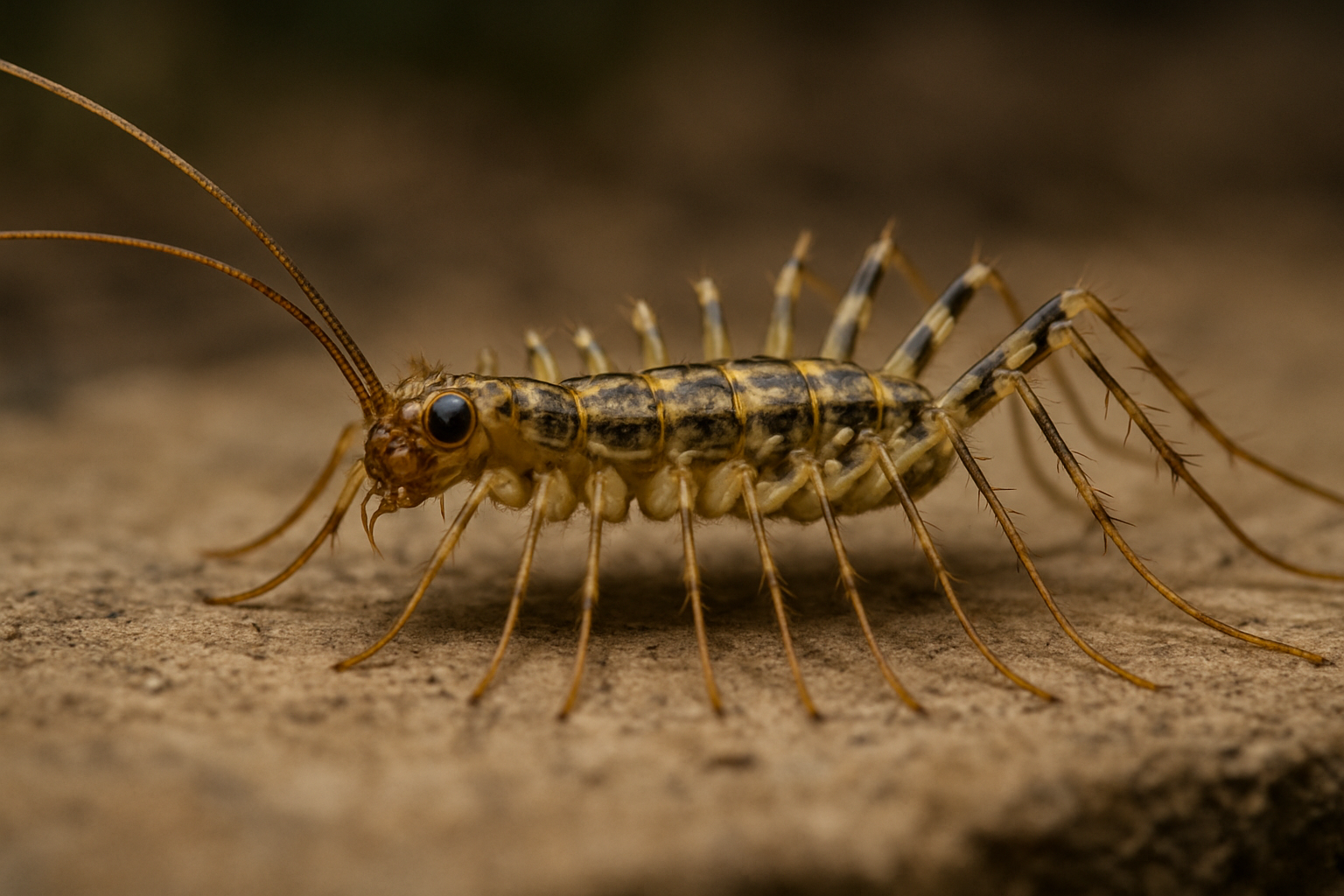
When we take a closer look at the less explored corners of our homes, we may encounter the intriguing Scutigera coleoptrata, better known as the house centipede. This fascinating arthropod, with its exquisitely segmented body, captures our attention not only for its physical peculiarities but also for the strangeness it evokes at first glance. Each segment of its sinuous body supports a pair of extremely fast legs, totaling up to thirty legs along its entire length, which gives the centipede formidable agility and the ability to climb smooth walls and ceilings with surprising ease.
The predominant colors in its anatomy range from yellow to brown, with patterns that may resemble a metallic exoskeleton, aiding in camouflage against natural predators such as spiders and birds. This is not just a visual detail; it reflects the complexity of a being evolved to survive in diverse environments, including domestic ones, where it plays a crucial role in preying on insects considered pests.
Its scientific name, Scutigera coleoptrata, originates from Latin, where ‘scutigera’ means ‘shield bearer’ and ‘coleoptrata’ refers to a form of covering or armor, highlighting the robustness and protection offered by its exoskeleton. However, despite its appearance and speed being initially disconcerting, it is precisely this combination of characteristics that allows it to adapt so efficiently to the spaces we inhabit.
Therefore, when we encounter a house centipede, it is important to recognize its ecological value. Instead of repulsion, careful observation can reveal the indispensable role this arthropod plays in the natural control of insects, which naturally benefits our domestic environment. In the next chapter, we will explore more deeply the behavior of the centipede in our daily lives, diving into the mysterious habits that govern its existence among us.
The Behavior of the House Centipede Indoors
As we delve into the intricate lives of the arthropods that share our space, we discover that the house centipede occupies a fascinating role. These prominent predators are essential in the natural control of pests, as they effectively hunt insects that often cause us problems.
Centipedes often hide in damp, dark places within homes, such as basements, bathrooms, and under piles of leaves or debris, emerging mainly at night. These periods of nocturnal activity are when they are most active in search of food, silently traversing the terrain to capture their prey. In their diet, they prefer common insects such as cockroaches, spiders, and mosquitoes, playing an essential role in maintaining ecological balance within the home.
Adaptable to urban environments, centipedes establish a fascinating example of coexistence with other small organisms, maintaining a relationship that, although little noticed, is vital for controlling various other pest species. The domestic environment, therefore, not only serves as shelter but becomes its own ecosystem where the centipede plays a leading role in pest control. To learn more about these and other arthropods in random environments, check out our article on urban pest incinerators.
So, as we contemplate these aspects, we can prepare the ground for the discussion in the next chapter about why, despite its fangs and venom, the house centipede does not pose a danger to humans.
Venom and Fangs: Why the House Centipede Does Not Pose a Danger to Humans
As we explore the fascinating world of the arthropods that inhabit our homes, we encounter the intriguing house centipede. Although these creatures may seem frightening at first glance, with their multiple legs and rapid movements, they bring with them a surprise in the form of defense that is, paradoxically, a delicately balanced mechanism for our safety.
The house centipede has fangs, called forcipules, which are adapted from its first legs. These fangs are capable of injecting venom to immobilize their prey, which are mostly small insects. The venom of the centipede is specific to its predatory function and, while effective against its insectivorous targets, is too weak to cause any significant harm to a human. Cases of bites in humans are exceptional and, in most cases, may result in slight redness or a burning sensation at the site, measures far removed from the effects of the venoms of more robust centipedes found in other habitats.
Moreover, unlike their wild relatives that exhibit considerable aggression, the house centipede tends to adopt a more reserved and defensive behavior. When confronted with a threat, the tendency is to flee, reserving the use of its venomous fangs as a last resort. This behavior indicates its nature adapted to peaceful coexistence, even in environments inhabited by humans.
In summary, the presence of these arthropods in our homes should not be a cause for alarm, but rather an opportunity to observe one of the many facets of domestic biodiversity. As we move forward to discover how to live harmoniously with the house centipede in the next chapter, it is worth reflecting on the ways these small beings contribute to the balance of our domestic environment.
How to Coexist with the House Centipede: Control and Prevention at Home
After exploring the biology and behavior of house centipedes, it is essential to discuss how we can peacefully coexist with these fascinating arthropods in our domestic environment.
The first step to prevent centipedes from entering the house is to understand that they seek humid environments. Therefore, an effective method is to control humidity inside the house. Use dehumidifiers and properly ventilate rooms, especially basements, bathrooms, and kitchens, as this will reduce the conducive environment for them to settle.
Prevention and Sealing
Sealing gaps and cracks in doors, windows, and foundations not only prevents the entry of centipedes but also other small insects that serve as food for them. Additionally, regular cleaning helps eliminate eggs and reduce the insect population inside the house, indirectly encouraging centipedes to seek other places to live. Keeping gardens and outdoor areas well-maintained and free of leaf or wood accumulation also discourages their presence.
Ethical Removal
When a centipede is found inside the house, it is recommended to safely and ethically remove it. Use a cup and a piece of paper to gently capture it and then release it in a natural outdoor environment, away from your residence. This action respects the animal’s well-being and maintains the natural balance.
With these measures, we can not only prevent the unwanted presence of centipedes in our homes but also appreciate the positive role they play in pest control, such as other insects that may be more harmful to the domestic environment. By understanding the methods for peaceful coexistence, we close the chapter with a gentler and more informed approach, preparing the ground to explore in the next chapter the fascinating curiosities of the house centipede and its intimate relationship with natural balance.
Fascinating Nature of the House Centipede: Curiosities and Significance
The Surprising Regeneration Ability
House centipedes, although they often give us the creeps, harbor fascinating adaptabilities. With a remarkable ability to regenerate, these creatures can replace lost legs during hasty escapes or conflicts. This phenomenon is not just a feat of survival but also a testament to the incredible resilience of nature within the home itself.
An Ecological Ally in the Domestic Environment
Despite their unsettling appearance, centipedes play a vital role in our homes. They help control pests by devouring insects that frequently cause greater damage to the domestic environment. Their presence also serves as a healthy indicator of ecological balance in our residences. These arthropods are true warriors in insect control, playing a crucial role in maintaining the health of our environment. Consequently, the house centipede is not just an intruder but a valuable indicator of an ecologically balanced home.
Did you enjoy this post? Like, comment, and share so we can keep creating! Our commitment is to inspire and inform about nature in all its places, whether indoors or in the vast world outside. Because by understanding the natural balance, we can all live better and more consciously with the incredible beings that share our space.
Conclusions…
The house centipede, or Scutigera coleoptrata, is an arthropod that arouses curiosity and even a bit of fear in people due to its distinctive appearance and presence in domestic environments. However, it is important to understand that it is harmless to humans, despite having fangs and venom. Its role is essential, as it helps control pests such as spiders and insects, contributing to the balance of fauna within the home. By understanding its habits, behavior, and physiological characteristics, we can better coexist with this fascinating species, avoiding misunderstandings and unnecessary actions. Our commitment is to promote a different perspective on the nature that inhabits our homes, revealing its surprises and inspiring a relationship of respect and admiration. So, did you enjoy this post? Like, comment, and share so we can continue creating content that unites science, curiosity, and love for the fauna and flora around us.
Did you know?
What is the house centipede?
The house centipede, scientifically known as Scutigera coleoptrata, is an arthropod that commonly inhabits domestic environments, known for its elongated body and many long legs.
Is the house centipede dangerous to humans?
No, despite having fangs and venom, the house centipede is harmless to humans and rarely bites, with its toxin being specific to small insects.
What is the role of the house centipede in the domestic environment?
It acts as an important pest controller, feeding on insects and spiders, contributing to the balance of the house’s ecosystem.
How to identify the house centipede at home?
It has an elongated, segmented body covered with long, thin legs, moving quickly, and is usually yellowish with dark stripes.
Where do house centipedes usually hide?
They tend to hide in damp, dark places, such as bathrooms, basements, baseboards, behind furniture, and in cracks in walls.
How to prevent the appearance of house centipedes at home?
Keeping the house clean, avoiding moisture accumulation, and sealing gaps and cracks help prevent these animals from entering and settling in the domestic environment.
Are house centipedes poisonous to other animals?
They have venom to paralyze their prey, such as insects and spiders, but do not pose a risk to larger animals like dogs and cats.
Should I kill the house centipede when I find it at home?
It is not recommended to kill them; they are beneficial for pest control. Prefer to capture them and release them outside, maintaining the balance of local fauna.