
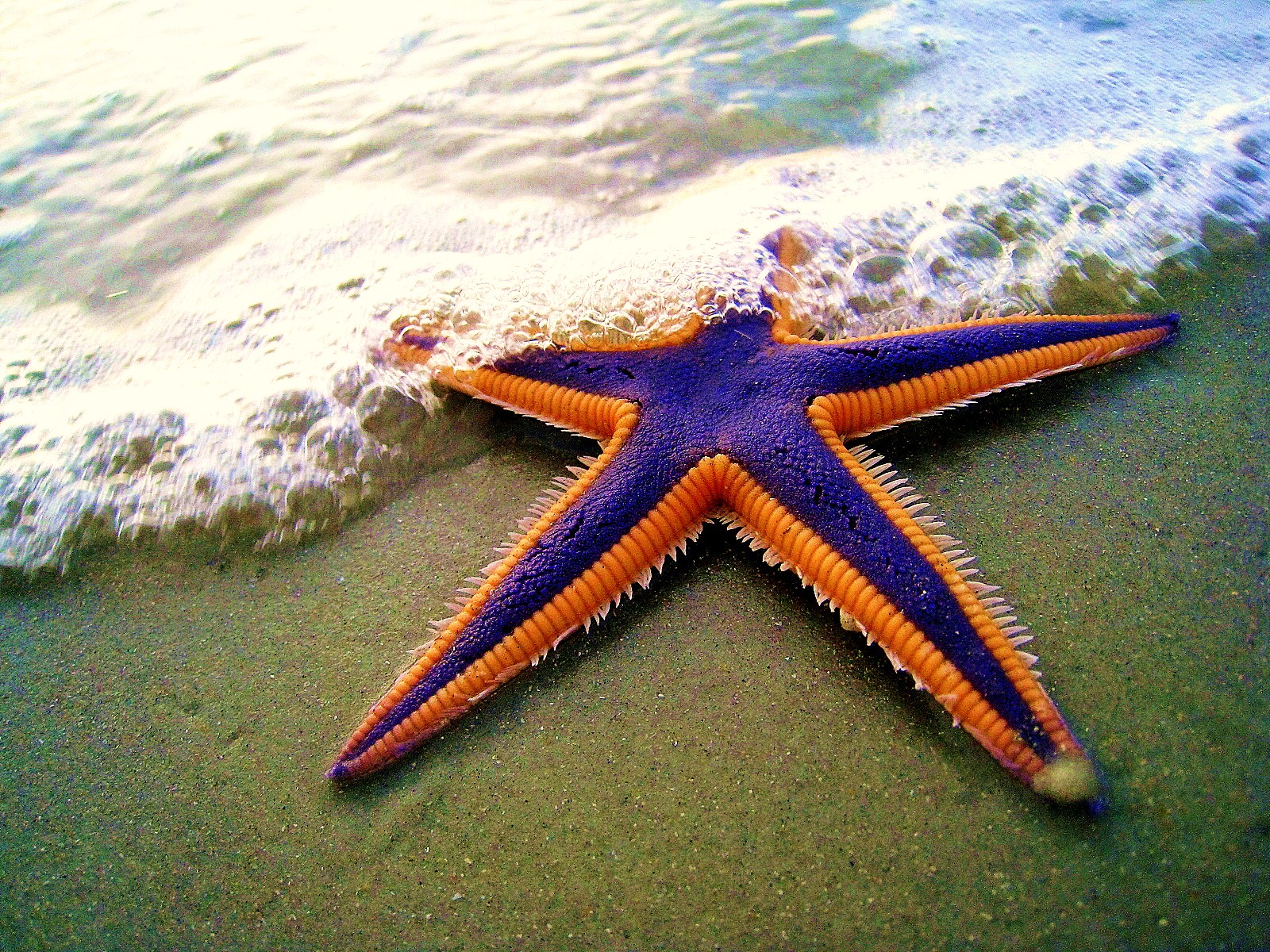
Discover the Starfish: Velvety and Agile
The starfish is a fascinating creature, whose locomotion abilities and adaptability in marine life intrigue biologists and curious minds. In this article, we will explore the world of these agile echinoderms, their unique characteristics, and the marine habitat they call home.
The Anatomy of Starfish
Starfish are captivating creatures, with an anatomy that reflects their adaptability to the marine environment. Commonly, they have five arms, although some species can have up to forty. These arms are not just for aesthetics; they are essential for locomotion and feeding. Each arm is filled with tiny tube feet, structures that act like suction cups, allowing them to cling to surfaces and navigate through rocks and corals.
The central disc is another key feature. It connects the arms and contains vital organs, such as the stomach, which can protrude outside the body during feeding. This projection ability is essential for capturing prey, such as mollusks and crustaceans. Digestion begins outside the body, which is an interesting strategy in their diet.
The locomotion of starfish can be described as elegant and efficient. Their tube feet are powered by a vascular system that uses water pressure to move each foot independently. This allows for smooth and controlled movement, contributing to their agility on the seafloor. Most starfish can walk in multiple directions, a feat that would be impossible without this complex structure.
Water is a crucial element in their locomotion. Without it, the vascular system would not function, hindering their ability to move and feed. In dry or polluted environments, starfish face serious challenges. To better understand the complexity of marine life, check out this interesting article about the smartest arachnid.
Amazing Locomotion Abilities
Starfish are fascinating creatures, known for their intriguing appearance and unique locomotion abilities. In a world where agility is often associated with rapid speed, these beauties of the deep sea stand out for their smooth and controlled movement. The secret to their mobility lies in a structure called tube feet, small tubes that connect to the starfish’s vascular system.
These feet, extending from each of their arms, resemble tiny tentacles, ready to move in harmony with the water. When a starfish wants to move, the vascular system, which operates on water, fills and contracts, allowing these feet to expand and contract. This not only enables the starfish to walk on hard surfaces but also gives them the ability to cling to irregular substrates, ensuring they are not swept away by wave forces.
Water plays a vital role in this mechanism. Without it, locomotion would be impossible. The aquatic environment is the center of their life, as it provides not only the means of transport but also the pressure necessary for the vascular system to operate effectively. Looking at other adaptations in nature, we can observe how different organisms adjust to their habitats in the same way that starfish adapt to their marine environment.
Changes in water conditions, such as temperature and salinity, directly influence their locomotion ability. Starfish, with their incredible dexterity, can explore reefs and sands, always in search of food or shelter. Each movement is a masterpiece of control and adaptation, revealing the beauty of marine life.
The Habitat of Starfish
Starfish are fascinating creatures that inhabit diverse environments, each with its unique characteristics. Coral reefs, these underwater spectacles of biodiversity, offer a resource-rich home. These ecosystems are teeming with life, where starfish find food and shelter. They typically spend the day hidden among the corals, taking advantage of the prey found there. When hunting, starfish display incredible agility, using their tube feet to navigate complicated terrains. This ability is vital in an environment where competition for food is fierce.
Along sandy beaches, starfish face different challenges. In this habitat, fine sand can hinder locomotion. However, starfish, always ready to adapt, use this sand to their advantage. They bury themselves to protect against predators and excessive heat. This adaptation reveals the cunning of these creatures. For example, by hiding, they can also surprise their prey.
In intertidal zones, starfish exhibit intriguing behavior. They move in response to changes in the water, exploring new territories. These variations affect not only their feeding but also their social interactions, which are essential for the species’ survival. Understanding the habitat of starfish is fundamental to appreciating their resilience. The beauty and complexity of these locations are comparable to other ecosystems, such as coral reefs. To learn more about the importance of reefs, check out this article on biodiversity.
The Ecological Relevance of Starfish
Starfish play a vital role in marine ecosystems. These creatures, with their exotic beauty and fascinating diversity, are key predators in their habitats. They regulate populations of mollusks, crustaceans, and other invertebrates. By doing so, they help maintain the ecological balance of the marine environment.
A notable example is the starfish Asterias rubens, which feeds on mussels. By controlling the population of these bivalves, the starfish prevents them from dominating the space, allowing for the coexistence of various species of marine organisms.
In addition to feeding on prey, these stars also interact in more complex ways. They can serve as shelter for small organisms, offering protection in a world where predation is a constant.
The impact of starfish on ocean health is undeniable. When populations of these stars decline, entire ecosystems can suffer. The uncontrolled increase of mollusks, for example, can lead to a decrease in biodiversity. This results in a domino effect, impacting other species and habitats.
On the other hand, the abundant presence of starfish signals a healthy ocean. They are part of a delicate balance that sustains marine life. Protecting these invertebrates is therefore crucial for the conservation of ocean ecosystems.
Interested in other fascinating species and their interactions? Discover how rhinoceroses, for example, also play important ecological roles in their vital habitats. Learn more at rhinoceros.
Conservation and Threats
Starfish, majestic creatures of the ocean, face various threats that compromise their survival. Marine pollution is one of the main causes of this challenge. Plastic waste and chemicals are often found in their habitats. This not only affects their health but also that of the ecosystems in which they live. Microplastic particles can be ingested, causing internal damage and compromising their vital functions. The consequences of this extend throughout the marine environment, destabilizing food webs.
In addition to pollution, climate change has a profound effect on starfish. Rising water temperatures compromise their ability to reproduce and stay healthy. Changes in salinity patterns and ocean chemistry also affect food availability. Coral bleaching, a direct consequence of climate change, further reduces the areas where these creatures can thrive.
Human exploitation also poses significant risks. Overharvesting, resulting from the aquatic trade, affects their populations. Often, starfish are captured without adequate consideration for sustainability, leading to a severe risk of extinction. Conservation initiatives are underway. Marine protected areas are being established, allowing these delicate beings to recover. Educating the public about the importance of starfish is crucial. Only through awareness and collective action can we ensure that these fascinating creatures remain in our oceans.
To learn more about the rich marine biodiversity and the importance of conservation, visit this link.
Conclusions…
In summary, the starfish exemplifies the beauty and complexity of the marine world. Its movement and adaptation abilities to aquatic life are a testament to the evolution and resilience of this fascinating species.
Did You Know?
What is the main characteristic of the starfish?
The main characteristic of the starfish is its radial symmetry, typically featuring five arms, and its ability to regenerate body parts.
Can you take a starfish out of the water?
While it is possible to take a starfish out of the water, this should be avoided as it can cause stress to the creature and even lead to its death if kept out of water for too long.
Where can you find starfish in Brazil?
Starfish can be found in various coastal regions of Brazil, especially in areas like Praia do Forte in Bahia and the coral reefs in the Northeast.
What is a star in the sea?
A starfish is a marine echinoderm belonging to the class Asteroidea, recognized for its star shape and presence in oceanic environments.
What is the danger of the starfish?
Some species of starfish have spines that can cause wounds, but most do not pose significant danger to humans.
Can you hold a starfish in your hand?
Yes, it is possible to hold a starfish with your hands, but care should be taken not to damage or stress it.
How long does a starfish live?
The lifespan of a starfish can vary, but many live between 5 to 10 years in natural environments.
Are there poisonous starfish?
Yes, some species of starfish have toxins that can be harmful if handled, but most are harmless.
How to keep a starfish alive?
To keep a starfish alive in an aquarium, it is necessary to ensure a proper environment, with clean water and adequate quality, as well as providing the correct feeding and maintaining stable temperature.