
The Fascinating Tiger Salamander
The Tiger Salamander, an impressive species native to North America, captivates all with its colorful yellow and black stripes. This article dives into the biology, habitat, behavior, and conservation efforts of this fascinating creature that inhabits the forests and ponds of the continent.
Physical Characteristics
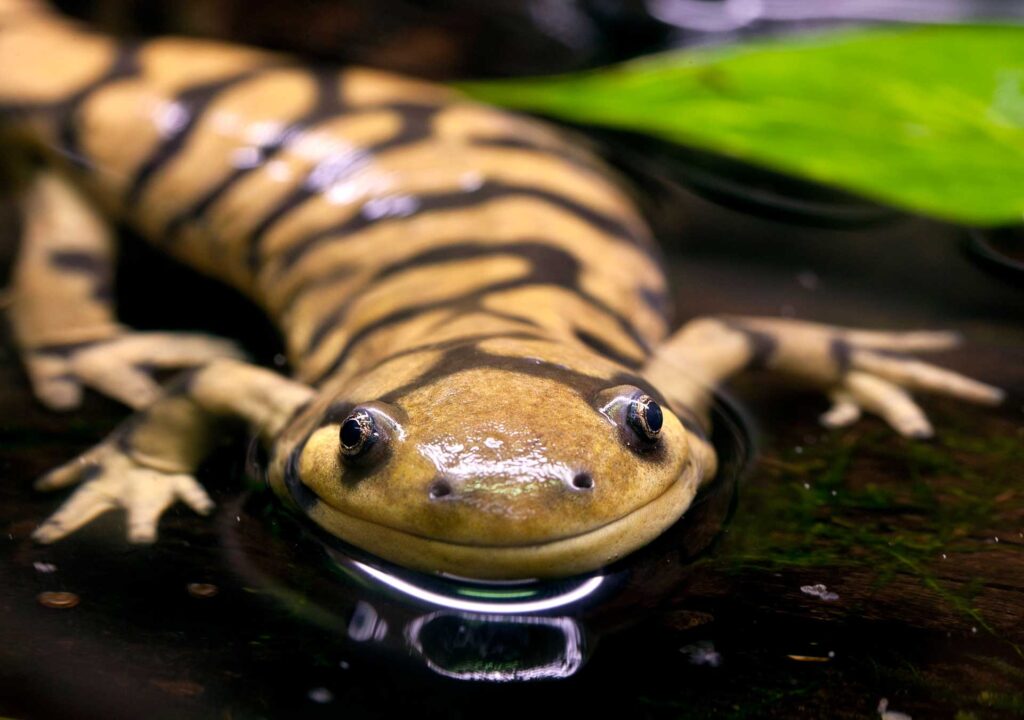
The Tiger Salamander, with its striking presence, enchants everyone who approaches it. Its body is covered in vibrant coloration, ranging from yellow to orange, speckled with black stripes. These stripes are not mere decorations; they play a vital role in camouflage and identification. When immersed in leaf-covered and shadowy environments, its coloration blends with the light and textures, allowing the salamander to hide from predators while standing out to mates during the breeding season.
This amphibian reaches an average length of 25 centimeters, although some individuals can grow even larger. Its robust shape and short legs are adaptations that make it agile in navigating uneven terrain. The skin is smooth, covered in mucus, which not only provides protection but also facilitates breathing, as the salamander can absorb oxygen through it. This feature is crucial since these creatures are aquatic in their youth, living underwater until they reach adulthood.
Moreover, the Tiger Salamander exhibits characteristics of aposematism. The bright coloration serves as a warning to potential predators, indicating that it may be toxic. This evolutionary strategy ensures a greater chance of survival, allowing this fascinating amphibian to continue thriving in its natural environment. To learn more about the relationship between adaptation and survival in other species, check out this article on the smartest arachnid.
Habitat and Distribution
The Tiger Salamander, known as the guardian of the forests, is closely linked to moist and shaded environments. This amphibian prefers habitats that offer a mosaic of dense forests and swampy areas. Its breeding sites are typically ponds and streams of freshwater, rich in vegetation. During the day, it resides under leaves and decaying logs. At night, the salamander takes advantage of the darkness to venture out in search of food. The geographical distribution of the Tiger Salamander spans vast areas of Western Europe and North America. Salamanders are primarily found in temperate forests, where humidity is constant. These environments provide the necessary moisture for their permeable skin. In Europe, they are common in countries like France, Germany, and the United Kingdom. In North America, they inhabit forests in the United States and Canada, where mild temperatures favor their survival. Another interesting characteristic of this salamander is its resilience to climate change and habitat degradation. Although they prefer natural environments, these salamanders can adapt to areas that have been slightly altered by human presence. Unfortunately, their existence is threatened by habitat loss, pollution, and climate change. The preservation of forests and wetlands is crucial for the continuity of the species. Thus, the Tiger Salamander is an indicator of a healthy ecosystem. Its presence is a sign that the environment is maintaining balance. For a more detailed analysis of the influence of ecological changes, see here.
Behavior and Diet
The Tiger Salamander is a fascinating being. This amphibian stands out for its intriguing behavior. During the day, it is often spotted in moist places, such as under leaves or stones. Here, it hides to avoid predators and conserve moisture. The main activities of the Tiger Salamander occur at dusk and night. During these periods, its active nature reveals itself. With keen eyes, it explores its territory in search of food. Generally, its diet consists of a variety of small invertebrates. It feeds on insects, worms, crustaceans, and spiders. Its ability to capture prey is impressive. With agile and quick movements, the Tiger Salamander uses its sticky tongue. Upon spotting prey, it darts its tongue out in a swift and precise motion. The tongue adheres to the prey, allowing the Tiger Salamander to pull it close. It is a spectacle worth witnessing. In addition to its hunting techniques, the Tiger Salamander adopts camouflage strategies. Its colors and patterns help it blend into the environment. Thanks to these characteristics, it becomes an effective predator and a difficult target for larger predators to identify. This balance between active and stealthy behavior is essential for its survival. In its rich and variable habitat, the combination of daytime and nighttime activities reflects how the Tiger Salamander adapts to its environment. For a deeper exploration of invertebrates and other nocturnal predators, visit Jumping Spider: The Smartest Arachnid.
Reproduction and Life Cycle
The reproduction of the pink mantis is an intriguing spectacle of nature. During mating, the male impresses the female with his elaborate dances. He approaches carefully, avoiding her iconic voracity. The female, while choosing a partner, observes his displays of strength and beauty.
After mating, an impressive phenomenon occurs: the practice of sexual cannibalism. Often, the female consumes the male, especially after fertilization. This interaction ensures that the female’s genetic qualities are passed on to the offspring, a strategy devoted to biology. However, not every male becomes prey. Some manage to distance themselves and escape.
After mating, the female is responsible for laying the eggs. On average, she deposits between 100 and 400 eggs, which are placed in a capsule called an ootheca. This structure protects the eggs from predators and external conditions and can be found in strategic locations, such as leaves or branches. The ootheca resembles a small log, camouflaging the eggs against predators.
After a few weeks, depending on environmental conditions, the hatchlings emerge. These young mantises are immediately on their own and must fend for themselves. Without parental guidance, they face a world full of dangers. Initially, they tend to be cannibalistic, feeding on their smaller siblings. Therefore, in their interactions, there is a struggle for survival. This fight for life and respect for hierarchy play a vital role in the life cycle of this fascinating insect. For more information on insect mating practices and social dynamics, see the article on squids.
Conservation and Threats
The Tiger Salamander faces a series of threats that affect its populations. Habitat degradation is one of the most significant. Urbanization, intensive agriculture, and deforestation reduce the natural spaces that these creatures call home. The ecosystems in which the salamander lives are often drained, polluted, and fragmented. This not only decreases the number of breeding sites but also creates barriers that isolate populations. With climate change, environmental conditions are changing rapidly, further exacerbating these challenges.
In addition to habitat degradation, the Tiger Salamander is vulnerable to diseases such as chytridiomycosis. This infection has devastated amphibian populations worldwide, and the Tiger Salamander is no exception. The effects of water pollution and the introduction of invasive species also hinder its survival.
Conservation efforts are underway to protect this fascinating species. Some projects focus on restoring natural habitats, creating corridors to allow movement between isolated populations. Researchers are monitoring populations and promoting awareness campaigns about the importance of the Tiger Salamander and its environment.
Community involvement is vital. People can help protect the Tiger Salamander by supporting local conservation initiatives and engaging in sustainable practices. This includes avoiding pollution of water bodies and keeping natural habitats intact. To learn more about these initiatives, you can visit the article on Brazilian water birds, which addresses the importance of preserving our ecosystems.
Conclusions…
The Tiger Salamander is a species that, besides impressing with its beauty, plays a vital role in its ecosystem. Protecting its habitat is essential for the survival of this fascinating species, and education is a key tool for this.
Did you know?
Where is the Tiger Salamander found?
The Tiger Salamander is found in forests and wet regions of North America, especially in areas like the United States and parts of Canada.
What is the size of the Tiger Salamander?
The Tiger Salamander can reach up to 25 centimeters in length, making it one of the largest salamander species in North America.
What are the main threats to the Tiger Salamander?
The main threats include habitat destruction due to urban development, climate change, and water pollution.
How can I help in the conservation of the Tiger Salamander?
By supporting conservation organizations, participating in environmental education programs, and avoiding the use of harmful chemicals in areas near natural habitats.